Fifth Sunday Of Lent Year B Psalm | Gospel And Acclamation

Fifth Sunday Of Lent Year B Psalm | Gospel And Acclamation

Responsorial Psalm For Fifth Sunday Of Lent Year B– Psalms 51:3-4, 12-13, 14-15.

R. (12a) Create a clean heart in me, O God.

3 Have mercy on me, O God, in your goodness;
in the greatness of your compassion wipe out my offense.
4 Thoroughly wash me from my guilt
and of my sin cleanse me.
R. Create a clean heart in me, O God.

12 A clean heart create for me, O God,
and a steadfast spirit renew within me.
13 Cast me not out from your presence,
and your Holy Spirit take not from me.
R. Create a clean heart in me, O God.

14 Give me back the joy of your salvation,
and a willing spirit sustain in me.
15 I will teach transgressors your ways,
and sinners shall return to you.
R. Create a clean heart in me, O God.

Gospel Acclamation For Fifth Sunday Of Lent Year B – John 12:26

26 Whoever serves me must follow me, says the Lord;
and where I am, there also will my servant be.

Gospel For Fifth Sunday Of Lent Year B – John 12:20-33

12:20 Now among those who went up to worship at the festival were some Greeks.

12:21 They came to Philip, who was from Bethsaida in Galilee, and said to him, “Sir, we wish to see Jesus.”

12:22 Philip went and told Andrew; then Andrew and Philip went and told Jesus.

12:23 Jesus answered them, “The hour has come for the Son of Man to be glorified.

12:24 Very truly, I tell you, unless a grain of wheat falls into the earth and dies, it remains just a single grain; but if it dies, it bears much fruit.

12:25 Those who love their life lose it, and those who hate their life in this world will keep it for eternal life.

12:26 Whoever serves me must follow me, and where I am, there will my servant be also. Whoever serves me, the Father will honor.

12:27 “Now my soul is troubled. And what should I say – ‘Father, save me from this hour’? No, it is for this reason that I have come to this hour.

12:28 Father, glorify your name.” Then a voice came from heaven, “I have glorified it, and I will glorify it again.”

12:29 The crowd standing there heard it and said that it was thunder. Others said, “An angel has spoken to him.”

12:30 Jesus answered, “This voice has come for your sake, not for mine.

12:31 Now is the judgment of this world; now the ruler of this world will be driven out.

12:32 And I, when I am lifted up from the earth, will draw all people to myself.”

12:33 He said this to indicate the kind of death he was to die.

Gospel For Fifth Sunday Of Lent Year B – John 12:20-33 In Nkwen

Àbòŋnǝ̀ Yesu Kristò ma Dzonǝ Ŋwà’anǝ̀ â ŋwa’arǝ, 12:20-33

All: Mәkwu’utәnә̀ dzwi a mbwo wwò, o Nfò wìi.

Bǝ̀ bǝ Grikǝ̀ bâtsǝ dzwi â tǝtǝ̌ bǝ̀ bu ma bwo ko’o nghǝ â ghu’usǝ Nywe njwe nghwe la. Bwo yii a mbwo Filibǝ̀ ma â  fu fǝ Betsayidà fǝfǝ Galili, nswiŋǝ a mbwo zhǝ ngǝ,  “Ndǝ̀, bìi swa’a zǝ̌ Yesù.” Filibǝ ghǝ swiŋǝ a mbwo Àndrǝya bwo zhǝ ti’i nghǝ fi’ìtǝ̀ a mbwo Yesù. Yesù a kwe a mbwo bwo ngǝ, “fǝ̀’ǝ̀ ku’u mǝ ngǝ bǝ fya aghu’usǝ̀ a mbwo Moo Ŋù.” Nǝ nkò’onyù mǝ̀ swiŋǝ a mbwo bù ngǝ, “Boŋǝ mboŋǝ ngwàsaŋǝ ka mǝmǝ̀ nshye wwo kwo, boŋǝ ə̀ bǝ tiŋǝ tsɛ’ɛ̀ mboŋǝ̀ mò’ò zuzu; la boŋǝ ǝ kwo boŋǝ ǝ̀ bǝ̌ jwe mbòŋǝ ngha’àtǝ̌. Bǝ̀ bu ma bwo koŋǝ mǝ̀dzwinǝ̀ mya bǝ bye la bu ma bwo banǝ mǝdzwinǝ̀ mya nshye wi bǝ liŋǝ nǝ mǝ̀dzwinǝ̀ ma mǝ lyǝ kǝ mye. Ŋù ntsǝ̀mǝ̀ wuma â fà’a mbwo mwo bǝ zoŋǝ̀ nǝ mwo. Â ŋù fà’à wa ntsǝmǝ̀ kǝ dzwi adi’i wuma mǝ̀ dzwi wǝ. Ŋù ntsǝmǝ̀ wuma â fa’a mbwo mwò Ətàa wà bǝ lya ghwu’usǝ yɛ.

Ntiŋǝ wa ghasǝ wa tsǝtsoŋnǝ̀, mǝ nti’i swiŋǝ ngǝ kǝ̀, ngǝ – ‘Ətàa wà, fusǝ wa mǝmǝ fǝ̀’ǝ̀ wǐ? Ngaŋǝ, mǝ̀ nyìi nkù’ù fǝ̀’ǝ̀ wu wi a mbǝ̀’ǝ anyù zu zǐ. Ətàà, ghwu’usǝ ǝlwenǝ̀ wwo. “Njì tsǝ̀ ti’i nfû nǝkàŋǝ̀ nswiŋǝ ngǝ, “Mǝ̀ ntɛ̌ nghu’usǝ, mǝ nkǝ bitǝ bǔ ghu’usǝ.” Ǹno bǝ̀ wu ma ə̂  tiŋǝ wu nzu’u nti’i nswiŋǝ ngǝ à bǝ̌ mbǝŋǝ̀ ma à khwùrǝ. Batsə nswiŋǝ ngǝ andzὲrǝ̀ bòŋnǝ a mbwo zhǝ. Yesù swiŋǝ ngǝ, “Njì zǐ yìi a mbǝ’ǝ wu, kakǝ mbǝ̀’ǝ̀ wa bǝ.” Li be Fè’ǝ̀ tsɛ̀rǝ nsa’a nshye. Bǝ̌ bǝ sǝ̀rǝ ǹlìnǝ nshye wi â ghǝ. Â mwò, fǝ̀’ǝ̀ wu ma bǝ lyǝ ntwe wa nshye ko’osǝ ndiŋǝ, mǝ̀ bǝ̂ lǒ bǝ̌ bǝ̀tsǝ̀mǝ̀ nǝbenǝ mwò. Â boŋnǝ li a mǝ dǝ̀sǝnǝ̀ mbuŋǝ̀ nǝ̀wwo zu ma zhǝ bǝ kwo.

Àbòŋnǝ̀ Yesu Kristò.

All: Nghu’usǝ̀ dzwì a mbwo wwo Nfò Yesu Kristò.

Free Translation

12:20 Now among those who went up to worship at the festival were some Greeks. Bǝ̀ bǝ Grikǝ̀ bâtsǝ dzwi â tǝtǝ̌ bǝ̀ bu ma bwo ko’o nghǝ â ghu’usǝ Nywe njwe nghwe la.

12:21 They came to Philip, who was from Bethsaida in Galilee, and said to him, “Sir, we wish to see Jesus.” Basic Division Without Remainders

12:22 Philip went and told Andrew; then Andrew and Philip went and told Jesus. Filibǝ ghǝ swiŋǝ a mbwo Àndrǝya bwo zhǝ ti’i nghǝ fi’ìtǝ̀ a mbwo Yesù.

12:23 Jesus answered them, “The hour has come for the Son of Man to be glorified. Yesù a kwe a mbwo bwo ngǝ, “fǝ̀’ǝ̀ ku’u mǝ ngǝ bǝ fya aghu’usǝ̀ a mbwo Moo Ŋù.”

12:24 Very truly, I tell you, unless a grain of wheat falls into the earth and dies, it remains just a single grain; but if it dies, it bears much fruit. Nǝ nkò’onyù mǝ̀ swiŋǝ a mbwo bù ngǝ, “Boŋǝ mboŋǝ ngwàsaŋǝ ka mǝmǝ̀ nshye wwo kwo, boŋǝ ə̀ bǝ tiŋǝ tsɛ’ɛ̀ mboŋǝ̀ mò’ò zuzu; la boŋǝ ǝ kwo boŋǝ ǝ̀ bǝ̌ jwe mbòŋǝ ngha’àtǝ̌.

12:25 Those who love their life lose it, and those who hate their life in this world will keep it for eternal life. Bǝ̀ bu ma bwo koŋǝ mǝ̀dzwinǝ̀ mya bǝ bye la bu ma bwo banǝ mǝdzwinǝ̀ mya nshye wi bǝ liŋǝ nǝ mǝ̀dzwinǝ̀ ma mǝ lyǝ kǝ mye.

12:26 Whoever serves me must follow me, and where I am, there will my servant be also. Whoever serves me, the Father will honor. Ŋù ntsǝ̀mǝ̀ wuma â fà’a mbwo mwo bǝ zoŋǝ̀ nǝ mwo. Â ŋù fà’à wa ntsǝmǝ̀ kǝ dzwi adi’i wuma mǝ̀ dzwi wǝ. Ŋù ntsǝmǝ̀ wuma â fa’a mbwo mwò Ətàa wà bǝ lya ghwu’usǝ yɛ.

12:27 “Now my soul is troubled. And what should I say – ‘Father, save me from this hour’? No, it is for this reason that I have come to this hour. Ntiŋǝ wa ghasǝ wa tsǝtsoŋnǝ̀, mǝ nti’i swiŋǝ ngǝ kǝ̀, ngǝ – ‘Ətàa wà, fusǝ wa mǝmǝ fǝ̀’ǝ̀ wǐ? Ngaŋǝ, mǝ̀ nyìi nkù’ù fǝ̀’ǝ̀ wu wi a mbǝ̀’ǝ anyù zu zǐ.

12:28 Father, glorify your name.” Then a voice came from heaven, “I have glorified it, and I will glorify it again.”Ətàà, ghu’usǝ ǝlwenǝ̀ wwo. “Njì tsǝ̀ ti’i nfû nǝkàŋǝ̀ nswiŋǝ ngǝ, “Mǝ̀ ntɛ̌ nghu’usǝ, mǝ nkǝ bitǝ bǔ ghu’usǝ.”

12:29 The crowd standing there heard it and said that it was thunder. Others said, “An angel has spoken to him.” Ǹno bǝ̀ wu ma ə̂  tiŋǝ wu nzu’u nti’i nswiŋǝ ngǝ à bǝ̌ mbǝŋǝ̀ ma à khwùrǝ. Batsə nswiŋǝ ngǝ andzὲrǝ̀ bòŋnǝ a mbwo zhǝ.

12:30 Jesus answered, “This voice has come for your sake, not for mine. Yesù swiŋǝ ngǝ, “Njì zǐ yìi a mbǝ’ǝ wu, kakǝ mbǝ̀’ǝ̀ wa bǝ.”

12:31 Now is the judgment of this world; now the ruler of this world will be driven out. Li be Fè’ǝ̀ tsɛ̀rǝ nsa’a nshye. Bǝ̌ bǝ sǝ̀rǝ ǹlìnǝ nshye wi â ghǝ.

12:32 And I, when I am lifted up from the earth, will draw all people to myself.” Â mwò, fǝ̀’ǝ̀ wu ma bǝ lyǝ ntwe wa nshye ko’osǝ ndiŋǝ, mǝ̀ bǝ̂ lǒ bǝ̌ bǝ̀tsǝ̀mǝ̀ nǝbenǝ mwò.

12:33 He said this to indicate the kind of death he was to die. Â boŋnǝ li a mǝ dǝ̀sǝnǝ̀ mbuŋǝ̀ nǝ̀wwo zu ma zhǝ bǝ kwo.

Nkwen Language Gospel Readings For Year B

Aspects Of The English Language

Responsorial Psalm Chants For Sundays

Nkwen Language Lessons

Inspired Writings

Nkwen Language Gospel Readings

Home

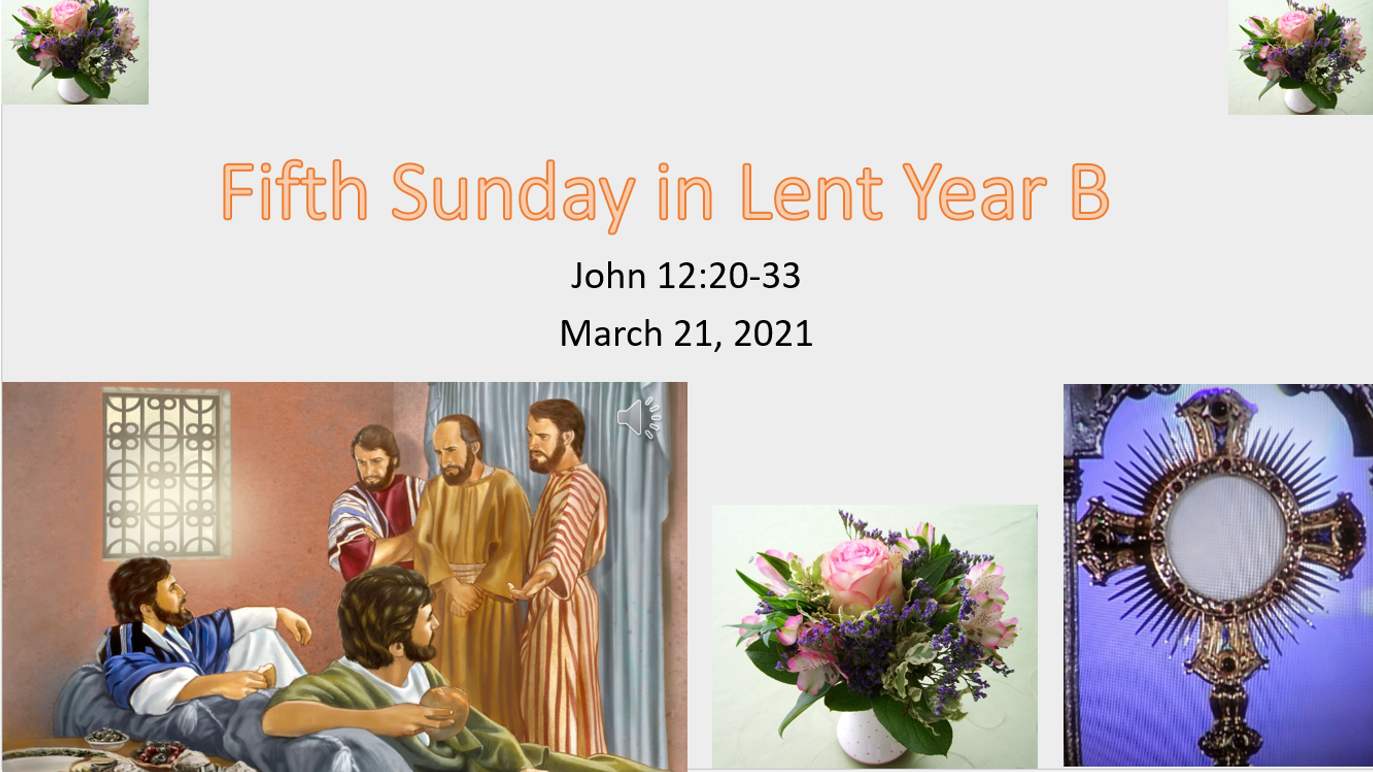
Fifth Sunday in Lent Year B

March 21, 2021

John 12:20-33

https://youtu.be/KVgxw0Mrrb0?list=PL_ihUsy6_PLLaTEQcKsWN8UQoDp4duUsY Fourth Sunday of Lent Gospel Year B Music With Local Instruments 1. My Songs and Lyrics NKWEN LANGUAGE LESSONS Greetings, family, Alphabet, Tone Marks, Numbers

12:20 Now among those who went up to worship at the festival were some Greeks.

12:21 They came to Philip, who was from Bethsaida in Galilee, and said to him, “Sir, we wish to see Jesus.”

12:22 Philip went and told Andrew; then Andrew and Philip went and told Jesus.

12:23 Jesus answered them, “The hour has come for the Son of Man to be glorified.

12:24 Very truly, I tell you, unless a grain of wheat falls into the earth and dies, it remains just a single grain; but if it dies, it bears much fruit.

12:25 Those who love their life lose it, and those who hate their life in this world will keep it for eternal life.

12:26 Whoever serves me must follow me, and where I am, there will my servant be also. Whoever serves me, the Father will honor.

12:27 “Now my soul is troubled. And what should I say – ‘Father, save me from this hour’? No, it is for this reason that I have come to this hour.

12:28 Father, glorify your name.” Then a voice came from heaven, “I have glorified it, and I will glorify it again.”

12:29 The crowd standing there heard it and said that it was thunder. Others said, “An angel has spoken to him.”

12:30 Jesus answered, “This voice has come for your sake, not for mine.

12:31 Now is the judgment of this world; now the ruler of this world will be driven out.

12:32 And I, when I am lifted up from the earth, will draw all people to myself.”

12:33 He said this to indicate the kind of death he was to die.

In Nkwen

Àbòŋnǝ̀ Yesu Kristò ma Dzonǝ Ŋwà’anǝ̀ â ŋwa’arǝ, 12:20-33

All: Mәkwu’utәnә̀ dzwi a mbwo wwò, o Nfò wìi.

Bǝ̀ bǝ Grikǝ̀ bâtsǝ dzwi â tǝtǝ̌ bǝ̀ bu ma bwo ko’o nghǝ â ghu’usǝ Nywe njwe nghwe la. Bwo yii a mbwo Filibǝ̀ ma â  fu fǝ Betsayidà fǝfǝ Galili, nswiŋǝ a mbwo zhǝ ngǝ,  “Ndǝ̀, bìi swa’a zǝ̌ Yesù.” Filibǝ ghǝ swiŋǝ a mbwo Àndrǝya bwo zhǝ ti’i nghǝ fi’ìtǝ̀ a mbwo Yesù. Yesù a kwe a mbwo bwo ngǝ, “fǝ̀’ǝ̀ ku’u mǝ ngǝ bǝ fya aghu’usǝ̀ a mbwo Moo Ŋù.” Nǝ nkò’onyù mǝ̀ swiŋǝ a mbwo bù ngǝ, “Boŋǝ mboŋǝ ngwàsaŋǝ ka mǝmǝ̀ nshye wwo kwo, boŋǝ ə̀ bǝ tiŋǝ tsɛ’ɛ̀ mboŋǝ̀ mò’ò zuzu; la boŋǝ ǝ kwo boŋǝ ǝ̀ bǝ̌ jwe mbòŋǝ ngha’àtǝ̌. Bǝ̀ bu ma bwo koŋǝ mǝ̀dzwinǝ̀ mya bǝ bye la bu ma bwo banǝ mǝdzwinǝ̀ mya nshye wi bǝ liŋǝ nǝ mǝ̀dzwinǝ̀ ma mǝ lyǝ kǝ mye. Ŋù ntsǝ̀mǝ̀ wuma â fà’a mbwo mwo bǝ zoŋǝ̀ nǝ mwo. Â ŋù fà’à wa ntsǝmǝ̀ kǝ dzwi adi’i wuma mǝ̀ dzwi wǝ. Ŋù ntsǝmǝ̀ wuma â fa’a mbwo mwò Ətàa wà bǝ lya ghwu’usǝ yɛ.

Ntiŋǝ wa ghasǝ wa tsǝtsoŋnǝ̀, mǝ nti’i swiŋǝ ngǝ kǝ̀, ngǝ – ‘Ətàa wà, fusǝ wa mǝmǝ fǝ̀’ǝ̀ wǐ? Ngaŋǝ, mǝ̀ nyìi nkù’ù fǝ̀’ǝ̀ wu wi a mbǝ̀’ǝ anyù zu zǐ. Ətàà, ghwu’usǝ ǝlwenǝ̀ wwo. “Njì tsǝ̀ ti’i nfû nǝkàŋǝ̀ nswiŋǝ ngǝ, “Mǝ̀ ntɛ̌ nghu’usǝ, mǝ nkǝ bitǝ bǔ ghu’usǝ.” Ǹno bǝ̀ wu ma ə̂  tiŋǝ wu nzu’u nti’i nswiŋǝ ngǝ à bǝ̌ mbǝŋǝ̀ ma à khwùrǝ. Batsə nswiŋǝ ngǝ andzὲrǝ̀ bòŋnǝ a mbwo zhǝ. Yesù swiŋǝ ngǝ, “Njì zǐ yìi a mbǝ’ǝ wu, kakǝ mbǝ̀’ǝ̀ wa bǝ.” Li be Fè’ǝ̀ tsɛ̀rǝ nsa’a nshye. Bǝ̌ bǝ sǝ̀rǝ ǹlìnǝ nshye wi â ghǝ. Â mwò, fǝ̀’ǝ̀ wu ma bǝ lyǝ ntwe wa nshye ko’osǝ ndiŋǝ, mǝ̀ bǝ̂ lǒ bǝ̌ bǝ̀tsǝ̀mǝ̀ nǝbenǝ mwò. Â boŋnǝ li a mǝ dǝ̀sǝnǝ̀ mbuŋǝ̀ nǝ̀wwo zu ma zhǝ bǝ kwo.

Àbòŋnǝ̀ Yesu Kristò.

All: Nghu’usǝ̀ dzwì a mbwo wwo Nfò Yesu Kristò.

Free Translation

12:20 Now among those who went up to worship at the festival were some Greeks. Bǝ̀ bǝ Grikǝ̀ bâtsǝ dzwi â tǝtǝ̌ bǝ̀ bu ma bwo ko’o nghǝ â ghu’usǝ Nywe njwe nghwe la.

12:21 They came to Philip, who was from Bethsaida in Galilee, and said to him, “Sir, we wish to see Jesus.” Basic Division Without Remainders

12:22 Philip went and told Andrew; then Andrew and Philip went and told Jesus. Filibǝ ghǝ swiŋǝ a mbwo Àndrǝya bwo zhǝ ti’i nghǝ fi’ìtǝ̀ a mbwo Yesù.

12:23 Jesus answered them, “The hour has come for the Son of Man to be glorified. Yesù a kwe a mbwo bwo ngǝ, “fǝ̀’ǝ̀ ku’u mǝ ngǝ bǝ fya aghu’usǝ̀ a mbwo Moo Ŋù.”

12:24 Very truly, I tell you, unless a grain of wheat falls into the earth and dies, it remains just a single grain; but if it dies, it bears much fruit. Nǝ nkò’onyù mǝ̀ swiŋǝ a mbwo bù ngǝ, “Boŋǝ mboŋǝ ngwàsaŋǝ ka mǝmǝ̀ nshye wwo kwo, boŋǝ ə̀ bǝ tiŋǝ tsɛ’ɛ̀ mboŋǝ̀ mò’ò zuzu; la boŋǝ ǝ kwo boŋǝ ǝ̀ bǝ̌ jwe mbòŋǝ ngha’àtǝ̌.

12:25 Those who love their life lose it, and those who hate their life in this world will keep it for eternal life. Bǝ̀ bu ma bwo koŋǝ mǝ̀dzwinǝ̀ mya bǝ bye la bu ma bwo banǝ mǝdzwinǝ̀ mya nshye wi bǝ liŋǝ nǝ mǝ̀dzwinǝ̀ ma mǝ lyǝ kǝ mye.

12:26 Whoever serves me must follow me, and where I am, there will my servant be also. Whoever serves me, the Father will honor. Ŋù ntsǝ̀mǝ̀ wuma â fà’a mbwo mwo bǝ zoŋǝ̀ nǝ mwo. Â ŋù fà’à wa ntsǝmǝ̀ kǝ dzwi adi’i wuma mǝ̀ dzwi wǝ. Ŋù ntsǝmǝ̀ wuma â fa’a mbwo mwò Ətàa wà bǝ lya ghwu’usǝ yɛ.

12:27 “Now my soul is troubled. And what should I say – ‘Father, save me from this hour’? No, it is for this reason that I have come to this hour. Ntiŋǝ wa ghasǝ wa tsǝtsoŋnǝ̀, mǝ nti’i swiŋǝ ngǝ kǝ̀, ngǝ – ‘Ətàa wà, fusǝ wa mǝmǝ fǝ̀’ǝ̀ wǐ? Ngaŋǝ, mǝ̀ nyìi nkù’ù fǝ̀’ǝ̀ wu wi a mbǝ̀’ǝ anyù zu zǐ.

12:28 Father, glorify your name.” Then a voice came from heaven, “I have glorified it, and I will glorify it again.Ətàà, ghu’usǝ ǝlwenǝ̀ wwo. “Njì tsǝ̀ ti’i nfû nǝkàŋǝ̀ nswiŋǝ ngǝ, “Mǝ̀ ntɛ̌ nghu’usǝ, mǝ nkǝ bitǝ bǔ ghu’usǝ.”

12:29 The crowd standing there heard it and said that it was thunder. Others said, “An angel has spoken to him.” Ǹno bǝ̀ wu ma ə̂  tiŋǝ wu nzu’u nti’i nswiŋǝ ngǝ à bǝ̌ mbǝŋǝ̀ ma à khwùrǝ. Batsə nswiŋǝ ngǝ andzὲrǝ̀ bòŋnǝ a mbwo zhǝ.

12:30 Jesus answered, “This voice has come for your sake, not for mine. Yesù swiŋǝ ngǝ, “Njì zǐ yìi a mbǝ’ǝ wu, kakǝ mbǝ̀’ǝ̀ wa bǝ.”

12:31 Now is the judgment of this world; now the ruler of this world will be driven out. Li be Fè’ǝ̀ tsɛ̀rǝ nsa’a nshye. Bǝ̌ bǝ sǝ̀rǝ ǹlìnǝ nshye wi â ghǝ.

12:32 And I, when I am lifted up from the earth, will draw all people to myself.” Â mwò, fǝ̀’ǝ̀ wu ma bǝ lyǝ ntwe wa nshye ko’osǝ ndiŋǝ, mǝ̀ bǝ̂ lǒ bǝ̌ bǝ̀tsǝ̀mǝ̀ nǝbenǝ mwò.

12:33 He said this to indicate the kind of death he was to die. Â boŋnǝ li a mǝ dǝ̀sǝnǝ̀ mbuŋǝ̀ nǝ̀wwo zu ma zhǝ bǝ kwo.

Click on the link below to go to related pages.

Nkwen Language Gospel Readings For Year B

Aspects Of The English Language

General Knowledge Questions and Answers Revision

Poems About Life

Responsorial Psalm Chants For Sundays
Nkwen Language Lessons

Basic Mathematics

Inspired Writings

Nkwen Language Gospel Readings

Home

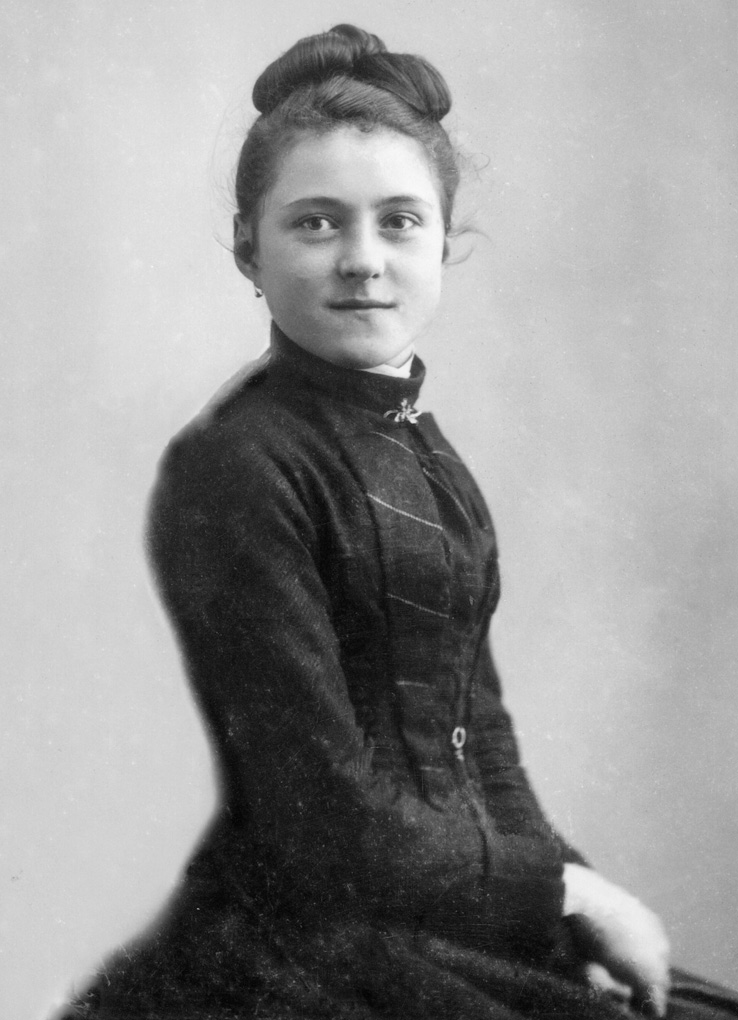
Saint Therese Of The Child Jesus My Patroness Amazes Me

Saint Therese of the Child Jesus 

WHO IS SHE?

Born on the 2nd of January 1873 at Alencon in France, Saint Therese of the Child Jesus was baptized two days after, on the 4th of January the same year. When she was growing up, she thought she would be a nun. She received her First Holy Communion on the 8th of May 1884 and was confirmed on the 14th of June the same year. On the 9th of April 1888, she entered the Carmelite Monastery at Lisieux as a Postulant, with the permission of her Father. She practiced the virtues of humility, evangelical simplicity, and firm confidence in God. She is my Patron Saint, Saint Therese of the Child Jesus, also known as Saint Therese of Lisieux and The Holy Face.

Saint Therese of the Child Jesus

HER INTERIOR SCHOOL

Therese of the Child Jesus is well known throughout the Church’s history as a doctor of souls. I once visited her school of holiness when I read her autobiography and decided to be a student in her school. This gentle soul in her interior school of holiness is awesome and can be very instrumental in the life of any Christian who turns to her intercession. I love reading her story again and again. Her prayer life as a whole, her schedule, and simple constant communion with God must have been the classroom where all teaching, learning, and research work took place for her to come out with her mission. Of course, her teacher is the Holy Spirit, and the Blessed Mother is her model.

HER MISSION

Therese of Lisieux
Therese of Lisieux
Therese of the Child Jesus

I’m always touched when I think of the kind of deep love Saint Therese had for God so much that in her last moment here on earth she declared her mission saying,

“I  feel that I am about to enter my rest … but I also feel that my mission is going to begin. My mission is to make God loved as I love him, to give my little ways to souls. If God grants my desire, my heaven will be lived on earth, until the end of time. This is not impossible since, from the very heart of the beatific vision, the angels watch over us”.

My mission is love P.9.

She developed a lot of confidence in God as I see in most of her writings, like this very heartfelt one,

O my God, Blessed Trinity I declare to love you and make you loved.”

I can see that she had a passionate desire to make God loved as she loves him or as they loved each other, a precious skill she must have acquired only in her interior school. Her self-discipline and openness in little things fostered a more significant encounter between God and herself that she intended to serve God even hereafter. I also learned that Therese’s mission actually started after her death, her mission to spend heaven on earth, if God grants her desires, to make God loved. She is one of the most loved saints nowadays because she keeps on fulfilling her mission: Making God’s children love him through her intercession – making Love loved. This Aspect of hers truly amazes me.

HER PRAYER LIFE

Therese of Lisieux
Therese of Lisieux

I’ve always thought prayer is “talking and listening to God” until I discovered more about prayer when I reflected on what my patroness wrote as a definition for prayer from her experience of prayer.

“A glance directed towards heaven, a cry of gratitude and love in the midst of trials and joys.” 

In her last conversation with her spiritual mother, Therese recounted a moment she encountered God’s glory.  She said,

“…well I was beginning the way of the cross and all of a sudden, I was seized with such a violent love for God that I cannot explain it except by saying that it was as if I had been totally plunged into fire. Oh! What fire and what sweetness at one and the same time! I was burning with love and I felt that one moment, one-second longer, and I could not have supported its ardor without dying. I understood what the saint said about this state that they had experienced so often. I experienced it only for an instant, and then I fell back into my usual state of dryness.

Therese’s attitude in prayer was that of abandonment. Even when it was difficult for her to meditate or reflect due to her health, her simplicity, peace of mind, and honesty in little things saw her being carried along by God’s love as a child carried in her Father’s arms. She longed to do great things, but her health could not permit her. In prayers, She was in-between being predominantly active and passive; thus, with no strength of her own, she left her heart predominantly open for the love of God to manifest itself to the fullest. How did she do this? By doing little things in extraordinary ways. We can learn from Therese that we can’t depend on our power to do things or to pray but on the grace of God’s love. 

Another amazing thing in her was her way of praying. Therese never cherished vocal prayers or could not stand a wearisome reiteration of words, but she prefers to silence all her personal circuits to give deep attention in listening to God. She realized that it is when she was in silence that God speaks to her, a very important aspect of her interior school. She wanted to be real as much as possible not to be drawn into ready-made prayers, but however, she said she loved the Divine office.

I also learned that Therese usually recites the ‘Our Father‘ prayer very slowly during her moments of spiritual dryness as she said,

“Sometimes when my mind is in such dryness, that it is impossible for me to draw one thought to unite myself with God I recite very slowly an ‘our Father’ then the angelic situation, this prayer carries me away, they nourish my soul so much more than if I had recited them quickly one hundred times.”

This simply means she took her time to get all the meaning and sweetness of every word, phrase, and sentence of the prayer. And this exercise usually carries her out of dryness into a soul-nourishing experience. Amazing!

HER RELATIONSHIP WITH THE VIRGIN MOTHER

Therese of Lisieux
Therese of Lisieux
The Virgin Mary
The Virgin Mother
THE VIRGIN MOTHER The Seven Sorrows of the Blessed Virgin Mary


Her relationship with the Virgin Mother was so real that she said,

“The Blessed Virgin shows me that she is not displeased with me and never fails to protect me as soon as I invoke her. I turn towards her and she always takes care of my needs as tenderness of a mother.”

This shows that in her interior school, Therese never despised the Virgin Mother she learned from her and obtained her benefits. She confirms she took care of her needs, which means her prayers through the Virgin Mother were always answered.

HER EARLY CHILDHOOD EXPERIENCE 

Saint Therese of the Child Jesus

Her radical faith and trust in God must have emanated from her early childhood experience of separation from her family. At the age of 3 years, due to ill health Therese was separated from her family and was only reunited after eleven months. This experience made her cling to her mother with a lot of passion. She could not endure being outside her mother’s presence. After her mother’s death, she clung to her family with the same zeal as she said,

“I could not bear the company of strangers and found my joy only within the intimacy of the Family.”

It is fantastic too that as Therese entered the convent, she clung to God in the same way she clung to her family. This childhood experience was just a glimpse of the interior school she came to establish as a nun, a preparation for what will come to pass in her life as a nun. Her unshakable or radical faith and dependence on God have gotten a significant contribution from her childhood experience.


HER ILL HEALTH

In sickness, Therese knew she had no strength to support herself but believed God would support her soul without her support. She believed she leans on a rock that holds her life and that she holds not the rock, but the rock holds her. This attitude of hers actually astonishes me.

In her interior institution, while learning a lot from God, the Father, Son, Holy Spirit, and Mother Mary, Saint Therese in some of her poems taught us many

Saint Therese of the Child Jesus

lessons such as abandonment, love, self-sacrifice, fortitude, tenderness, purity, etc. To understand and imitate her life is to make us men, women, brothers, and sisters of faith. Just as she taught her novices with her words and examples, so she is teaching us today. Here are two of her amazing poems:

A GLOSS ON THE DIVINE (by Saint Therese of the Child Jesus)

“Without support, yet with support. 

Living without light, in darkness, 

I am wholly being consumed by love.

 I have no other support than my God. 

And now I proclaim what I value near him.

Is to see and feel my soul 

Supported without any support.”

Therese of the Child Jesus

When I read this poem the first time, I was like startled, and then I asked myself, “what is the meaning of ‘gloss’?” From my dictionary and got it,

gloss

/ɡläs/

noun

  • 1. shine or luster on a smooth surface.

I was so moved as this definition made me understand the poem better. Amazingly, I see how this gentle soul describes her smooth leaning on God, her self abandonment in God’s hands, especially in moments when her heart was willing, but her body could not take her to where she wished to reach in her calling due to her ill health.

LIVING ON LOVE (by Saint Therese of the Child Jesus)

“Living on love is giving without limit.

Without claiming any value here below. 

Ah! I give without counting, truly sure. 

That when one loves one does not keep counts! 

Overflowing with tenderness, I have given everything.

To his divine heart… lightly I run.

I have nothing left but my only wealth

Living on love.

Living on love is banishing every fear. 

Every memory of past faults.

I see no imprint of my sins.

In a moment love has burnt out everything.”

Therese of the Child Jesus

Wow! what a love song. If there is a word in the whole wide world so difficult to define, it is “LOVE,” but here is a very simple, very true definition of love from a pure heart. Amazing! “Giving without limit, without counting, overflowing with tenderness, banishing fear, etc.”

CANONIZATION OF SAINT THERESE

Saint Therese of the Child Jesus

“After her death on the 30th of September 1897, at the age of 24, Saint Therese was declared venerable by Pope Benedict XV in 1921. In 1923 Pope Pius XI promulgated a decree which beatified Therese, describing her as the “Star of his Pontifical reign.” Finally, on the 17th of May 1925, Therese Martin, also known as Saint Therese of the Child Jesus and the Holy Face, was canonized at St. Peter’s Basilica in the presence of thirty-four cardinals, more than two hundred Arch Bishops and Bishops, innumerable priests religious and others. The Basilica was decorated with garlands of roses. She was also proclaimed a doctor of the Church.”

In fact, I’m impressed at the number of people present at her canonization, which indicates how Therese had touched the lives of many with her simple ways. This inevitably came to pass as a result of her dedication to her interior school, where she listened, communicated, and acted according to God’s will for her. She is said to be one of the most loved saints of this century because she keeps on fulfilling her mission. She is the woman most loved by the world after the mother of God. A doctor has done a lot of research, passed several exams, and is an expert in his work field. So was Saint Therese in her vocation. She did little things in extraordinary ways showing us that it is not only in doing great and mighty things that one deserves this title. Yes, she died but still lives and has visited so many countries of the world, something she wished she could do while on earth but was limited by health.

Saint Therese of the Child Jesus

Her Intercessory Power

Saint Therese of the Child Jesus

I was so astonished when I read about her intercessory power and decided to seek her intercession one time I had difficulty. I prayed the “Glory Be Novena to Saint Therese.”

I was standing in front of the whole school that morning, conducting morning devotion. The latecomers had been stopped from running in except for the kindergartens who were allowed to join their mates on their line. Suddenly, up came one of the latecomers, my class kids, Tumi, running directly towards me with a flower in hand. He must have harvested it on his way to school, for he lives on a hillside two kilometers from the school compost. The other pupils watched with amazement, eager to see what Tumi will be up to. Innocently, he offered me the flower saying, “Madam, take your ‘fiawer’. ” The whole school burst into laughter. 😁😁😁 Tumi was so happy😀as I received the flower, carried him up, and embraced him. No one could understand what this was all about, but I, who have read that Saint Therese usually indicates answered prayers with flower signs. This happens the first time I took the novena. I thought it was a coincidence, but my second experience made me actually believe it.

I was kneeling in front of the Blessed Sacrament on the 9th day of my Novena to Saint Therese of the Child Jesus, and as I was meditating, my eyes caught the bouquet of flowers that was standing at the altar. Just of a sudden, a rose left the bouquet and fell on the floor. This again to me was a confirmation of answered prayers through Saint Therese, and this made me believe that what is said of her is true that when you seek her intercession, she mostly shows signs of answered prayers with flowers. No doubt, she is also popularly known as “The Little Flower of Jesus,” or only “The Little Flower.

Truly my patroness amazes me, and I’m proud to be a student in her school. She is one of the greatest saints of modern times.

Click on the link below to go to related pages.

Nkwen Language Gospel Readings For Year B

Aspects Of The English Language

General Knowledge Questions and Answers Revision

Poems About Life

Responsorial Psalm Chants For Sundays

Nkwen Language Lessons

Basic Mathematics

Inspired Writings

Nkwen Language Gospel Readings

Home

https://youtube.com/c/TaminangThereseN


My Patroness Amazes Me

https://youtube.com/c/TaminangThereseN

WHO IS SHE?

Born on the 2nd of January 1873 at Alencon in France, she was baptized two days after, on the 4th of January same year. When she was growing up, she thought she would be a nun. She received her First Holy Communion on the 8th of May 1884 and was confirmed on the 14th of June the same year. On the 9th of April 1888, she entered the Carmelite Monastery at Lisieux as a Postulant, at the permission of her Father. She practiced the virtues of humility, evangelical simplicity, and firm confidence in God. She is my Patron Saint, Therese of the Child Jesus, also known as Saint Therese of Lisieux and The Holy Face.

The Holy Face
Saint Therese of Lisieux.

HER INTERIOR SCHOOL

Therese of the Child Jesus is well known throughout the Church’s history as a doctor of souls. I once visited her school of holiness when I read her autobiography and decided to be a student in her school. This gentle soul in her interior school of holiness is awesome and can be very instrumental in the life of any Christian who turns to her intercession. I love reading her story again and again. Her prayer life as a whole, her schedule, and simple constant communion with God must have been the classroom where all teaching, learning, and research work took place for her to come out with her mission. Of course, her teacher being the Holy Spirit, and the Blessed Mother her model.

HER MISSION

Therese of the Child Jesus

I’m always touched when I think of the kind of deep love Saint Therese had for God so much that in her last moment here on earth she declared her mission saying,

“I  feel that I am about to enter my rest … but I also feel that my mission is going to begin. My mission is to make God loved as I love him, to give my little ways to souls. If God grants my desire, my heaven will be lived on earth, until the end of time. This is not impossible since, from the very heart of the beatific vision, the angels watch over us”.

My mission is love P.9.

She developed a lot of confidence in God as I see in most of her writings, like this very heartfelt one,

O my God, Blessed Trinity I declare to love you and make you loved.”

Therese of the Child Jesus

I can see that she had a passionate desire to make God loved as she loves him or as they loved each other, a precious skill she must have acquired only in her interior school. Her self-discipline and openness in little things fostered a more significant encounter between God and herself that she intended to serve God even hereafter. I also learned that Therese’s mission actually started after her death, her mission to spend heaven on earth, if God grants her desires, to make God loved. She is one of the most loved saints nowadays because she keeps on fulfilling her mission: Making God’s children love him through her intercession – making Love loved. This Aspect of hers truly amazes me.

HER PRAYER LIFE

I’ve always thought prayer is “talking and listening to God” until I discovered more about prayer when I reflected on what my patroness wrote as a definition for prayer from her experience of prayer.

“A glance directed towards heaven, a cry of gratitude and love in the midst of trials and joys.” 

Therese of the Child Jesus

In her last conversation with her spiritual mother, Therese recounted a moment she encountered God’s glory.  She said,

“…well I was beginning the way of the cross and all of a sudden, I was seized with such a violent love for God that I cannot explain it except by saying that it was as if I had been totally plunged into fire. Oh! What fire and what sweetness at one and the same time! I was burning with love and I felt that one moment, one-second longer, and I could not have supported its ardor without dying. I understood what the saint said about this state that they had experienced so often. I experienced it only for an instant, and then I fell back into my usual state of dryness.”

Therese of the Child Jesus

Therese’s attitude in prayer was that of abandonment. Even when it was difficult for her to meditate or reflect due to her health, her simplicity, peace of mind, and honesty in little things saw her being carried along by God’s love as a child carried in her Father’s arms. She longed to do great things, but her health could not permit her. In prayers, She was in-between being predominantly active and passive; thus, with no strength of her own, she left her heart predominantly open for the love of God to manifest itself to the fullest. How did she do this? By doing little things in extraordinary ways. We can learn from Therese that we can’t depend on our power to do things or to pray but on the grace of God’s love. 

Another amazing thing in her was her way of praying. Therese never cherished vocal prayers or could not stand a wearisome reiteration of words, but she prefers to silence all her personal circuits to give deep attention in listening to God. She realized that it is when she was in silence that God speaks to her, a very important aspect of her interior school. She wanted to be real as much as possible not to be drawn into ready-made prayers, but however, she said she loved the Divine office.

I also learned that Therese usually recites the ‘Our Father‘ prayer very slowly during her moments of spiritual dryness as she said,

“Sometimes when my mind is in such dryness, that it is impossible for me to draw one thought to unite myself with God I recite very slowly an ‘our Father’ then the angelic situation, this prayer carries me away, they nourish my soul so much more than if I had recited them quickly one hundred times.”

Therese of the Child Jesus

This simply means she took her time to get all the meaning and sweetness of every word, phrase, and sentence of the prayer. And this exercise usually carries her out of dryness into a soul-nourishing experience. Amazing!

HER RELATIONSHIP WITH THE VIRGIN MOTHER

THE VIRGIN MOTHER The Seven Sorrows of the Blessed Virgin Mary


Her relationship with the Virgin Mother was so real that she said,

“The Blessed Virgin shows me that she is not displeased with me and never fails to protect me as soon as I invoke her. I turn towards her and she always takes care of my needs as tenderness of a mother.”

Therese of the Child Jesus

This shows that in her interior school, Therese never despised the Virgin Mother she learned from her and obtained her benefits. She confirms she took care of her needs, which means her prayers through the Virgin Mother were always answered.

HER EARLY CHILDHOOD EXPERIENCE 

Her radical faith and trust in God must have emanated from her early childhood experience of separation from her family. At the age of 3 years, due to ill health Therese was separated from her family and was only reunited after eleven months. This experience made her clung to her mother with a lot of passion. She could not endure being outside her mother’s presence. After her mother’s death, she clung to her family with the same zeal as she said,

“I could not bear the company of strangers and found my joy only within the intimacy of the Family.”

Therese of the Child Jesus

It is fantastic too that as Therese entered the convent, she clung to God in the same way she clung to her family. This childhood experience was just a glimpse of the interior school she came to establish as a nun, a preparation of what will come to pass in her life as a nun. Her unshakable or radical faith and dependence on God have gotten a significant contribution from her childhood experience.

HER ILL HEALTH

In sickness, Therese knew she had no strength to support herself but believed God would support her soul without her support. She believed she leans on a rock that holds her life and that she holds not the rock, but the rock holds her. This attitude of hers actually astonishes me.

In her interior institution, while learning a lot from God, the Father, Son, Holy Spirit, and Mother Mary, Saint Therese in some of her poems taught us many lessons such as abandonment, love, self-sacrifice, fortitude, tenderness, purity, etc. To understand and imitate her life is to make us men, women, brothers, and sisters of faith. Just as she taught her novices with her words and examples, so she is teaching us today. Here are two of her amazing poems:

A GLOSS ON THE DIVINE

“Without support, yet with support. 

Living without light, in darkness, 

I am wholly being consumed by love.

 I have no other support than my God. 

And now I proclaim what I value near him.

Is to see and feel my soul 

Supported without any support.”

Therese of the Child Jesus

When I read this poem the first time, I was like startled, and then I asked myself, “what is the meaning of ‘gloss’?” From my dictionary and got it,

gloss

/ɡläs/

noun

  • 1.shine or luster on a smooth surface.

I was so moved as this definition made me understand the poem better. Amazingly, I see how this gentle soul describes her smooth leaning on God, her self abandonment in God’s hands, especially in moments when her heart was willing, but her body could not take her to where she wishes to reach in her calling due to her ill health.

LIVING ON LOVE

“Living on love is giving without limit.

Without claiming any value here below. 

Ah! I give without counting, truly sure. 

That when one loves one does not keep counts! 

Overflowing with tenderness, I have given everything.

To his divine heart… lightly I run.

I have nothing left but my only wealth

Living on love.

Living on love is banishing every fear. 

Every memory of past faults.

I see no imprint of my sins.

In a moment love has burnt out everything.”

Therese of the Child Jesus

Wow! what a love song. If there is a word in the whole wide world so difficult to define, it is “LOVE,” but here is a very simple, very true definition of love from a pure heart. Amazing! “Giving without limit, without counting, overflowing with tenderness, banishing fear, etc.”

CANONIZATION OF SAINT THERESE

Saint Therese of the Child Jesus

“After her death on the 30th of September 1897, at the age of 24, Saint Therese was declared venerable by Pope Benedict XV in 1921. In 1923 Pope Pius XI promulgated a decree which beatified Therese, describing her as the “Star of his Pontifical reign.” Finally, on the 17th of May 1925, Therese Martin, also known as Saint Therese of the Child Jesus and the Holy Face, was canonized at St. Peter’s Basilica in the presence of thirty-four cardinals, more than two hundred Arch Bishops and Bishops, innumerable priests religious and others. The Basilica was decorated with garlands of roses. She was also proclaimed a doctor of the Church.”

In fact, I’m impressed at the number of people present at her canonization, which indicates how Therese had touched the lives of many with her simple ways. This inevitably came to pass as a result of her dedication to her interior school, where she listened, communicated and acted according to God’s will for her. She is said to be one of the most loved saints of this century because she keeps on fulfilling her mission. She is the woman most loved by the world after the mother of God. A doctor has done a lot of research, passed several exams, and is an expert in his work field. So was Saint Therese in her vocation. She did little things in extraordinary ways showing us that it is not only in doing great and mighty things that one deserves this title. Yes, she died but still lives and has visited so many countries of the world, something she wished she could do while on earth but limited by health.

Saint Therese of the Child Jesus

Her Intercessory Power

I was so astonished when I read about her intercessory power and decided to seek her intercession one time I had difficulty. I prayed the “Glory Be Novena to Saint Therese.”

I was standing in front of the whole school that morning, conducting morning devotion. The latecomers had been stopped from running in except the kindergartens who were allowed to join their mates on their line. Suddenly, up came one of the latecomers, my class kids, Tumi, running directly towards me with a flower in hand. He must have harvested it on his way to school, for he lives on a hillside two kilometers from the school compost. The other pupils watched with amazement, eager to see what Tumi will be up to. Innocently, he offered me the flower saying, “Madam, take your ‘fiawer’. ” The whole school burst into laughter. 😁😁😁 Tumi was so happy😀as I received the flower, carried him up, and embraced him. No one could understand what this was all about, but I who have read that Saint Therese usually indicates answered prayers with flower signs. This happens the first time I took the novena. I thought it was a coincidence, but my second experience made me actually believe.

I was kneeling in front of the Blessed Sacrament on the 9th day of my Novena to Saint Therese of the Child Jesus, and as I was meditating, my eyes caught the bouquet of flowers that was standing at the altar. Just of a sudden, a rose left the bouquet and fell on the floor. This again to me was a confirmation of answered prayers through Saint Therese, and this made me believe that what is said of her is true that when you seek her intercession, she mostly shows signs of answered prayers with flowers. No doubt, she is also popularly known as “The Little Flower of Jesus,” or only “The Little Flower.

Truly my patroness amazes me, and I’m proud to be a student in her school. She is one of the greatest saints of modern times.

Click on the link below to go to related pages.

Nkwen Language Gospel Readings For Year B

Aspects Of The English Language

General Knowledge Questions and Answers Revision

Poems About Life

Responsorial Psalm Chants For Sundays

Nkwen Language Lessons

Basic Mathematics

Inspired Writings

Nkwen Language Gospel Readings

Home

https://youtube.com/c/TaminangThereseN

Fourth Sunday of Lent, Year B Gospel, Psalm And Gospel Acclamation

Fourth Sunday of Lent, Year B Gospel, Psalm, And Gospel Acclamation

Responsorial Psalm For Fourth Sunday of Lent Year B– Psalms 137:1-2, 3, 4-5, 6.

R. (6ab) Let my tongue be silenced if I ever forget you!

1 By the streams of Babylon
we sat and wept
when we remembered Zion.
2 On the aspens of that land
we hung up our harps.
R. Let my tongue be silenced, if I ever forget you!

3 For there our captors asked of us
the lyrics of our songs,
And our despoilers urged us to be joyous:
“Sing for us the songs of Zion!”
R. Let my tongue be silenced, if I ever forget you!

4 How could we sing a song of the LORD
in a foreign land?
5 If I forget you, Jerusalem,
may my right hand be forgotten!
R. Let my tongue be silenced, if I ever forget you!

6 May my tongue cleave to my palate
if I remember you not,
If I place not Jerusalem
ahead of my joy.
R. Let my tongue be silenced, if I ever forget you!

Gospel For Fourth Sunday of Lent Year B Gospel John 3:14-21

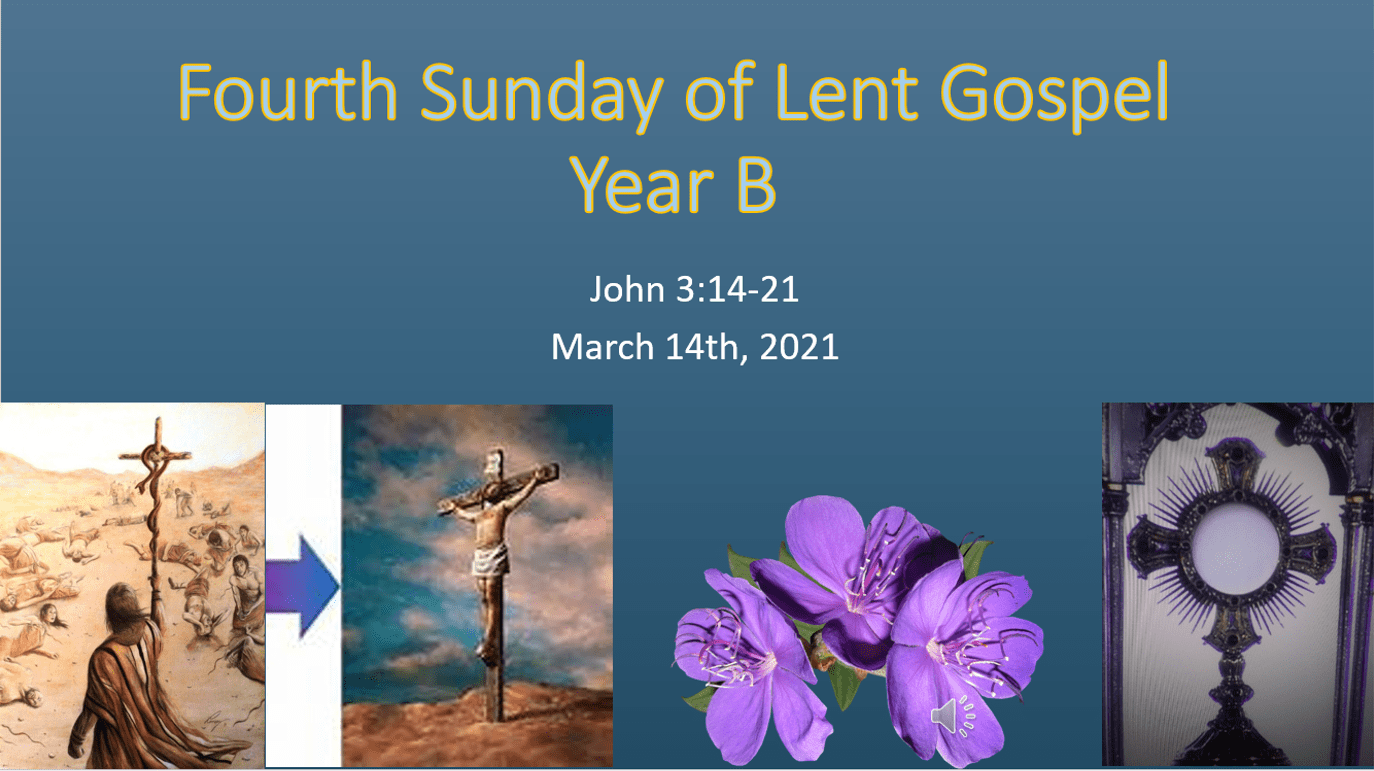
Jesus said to Nicodemus: 14 “Just as Moses lifted up the serpent in the desert, so must the Son of Man be lifted up

15 so that everyone who believes in him may have eternal life.”

16 For God so loved the world that he gave his only Son, so that everyone who believes in him might not perish but might have eternal life

17 For God did not send his Son into the world to condemn the world, but that the world might be saved through him.

18 Whoever believes in him will not be condemned, but whoever does not believe has already been condemned, because he has not believed in the name of the only Son of God.

19 And this is the verdict, that the light came into the world, but people preferred darkness to light, because their works were evil.

20 For everyone who does wicked things hates the light and does not come toward the light, so that his works might not be exposed.

21 But whoever lives the truth comes to the light, so that his works may be clearly seen as done in God.

Gospel For Fourth Sunday of Lent Year B Gospel In Nkwen


Sunday Gospel Readings Playlist

Àbòŋnǝ̀ Yesu Kristò ma Dzonə̀ Ŋwà’anǝ̀ â ŋwa’arǝ, 3:14-21

All: Mәkwu’utәnә̀ dzwi a mbwo wwò, o Nfò wìi.

Yesù â swiŋǝ a mbwo Nikodemusǝ̀ ngǝ, “Bǝ̌ be lya kǝ ku’usǝ Moo Ŋù gaŋǝ ndǝŋǝ tsuŋǝ̀ ma Mose ku’usǝ fǝ̀nye fya adi’i waŋsǝ-nshye la, ngǝ ŋu ntsǝ̀mǝ̀ wu ma à biŋǝ mbwo zhə â dzwi nǝ mèdzwinǝ̀ ma mǝ lyǝ kǝ mye. mbǝ’ǝma Nywe koŋǝ nshye zi susu, titi nchyasǝ Moo yi wi mo’o ngǝ ŋù ntsǝ̀mǝ̀ wu ma à biŋǝ a mbwo zhǝ bǝ̌ kàkǝ yi kwo la dzwi nǝ mǝ̀dzwinǝ̀ ma mǝ lye kǝ mye. Mbǝ’ǝma ŋù ntsǝ̀mǝ̀ wu ma a ghǝ̀rǝ mǝnyù mǝ tǝbòŋǝ̀ a banǝ̀ nkà’à, kàkǝ yi nǝbenǝ nka’a nyǐtǝ̂, mǝ ngǝ̌ mǝ̀nyù myi kǝ nǝ kɛ̌nǝ.Mbǝ’ǝma Nywe bikàkǝ̌ Moo yi chyasǝ̀ bǝ ngǝ a yii mbusǝ nshye, la bǝ ngǝ nshye fu mǝmǝ̀ ngǝ’ǝ mbǝ’ǝ yɛ.

Bǝ̂ bǝ kàkǝ ŋu wu ma à biŋǝ mbwo zhǝ chǝ̌ lo’o, la ŋù wu ma à bikàkǝ mbwo zhǝ biŋǝ bǝ tɛ nlo’o yɛ, mbǝ’ǝma à bikàkǝ mbwo Moo Nywe wi mò’o biŋǝ̀. Li ti’i mbǝ mǝtsɛ̀rǝnǝ mǝ nsa’à ngǝ, nkà’a yii mǝmǝ̀ nshyê la bǝ koŋǝ bǝ nsenǝdi’i nchyâtǝ nkà’a, mbǝ’ǝma mǝ̀fà’à mya bǝ mà tǝbòŋǝ̀. La ŋù wu ma mǝ̀dzwinǝ myi bǝ nko’onyù a yìi mǝmǝ̀ nkà’à, mǝ ngǝ bǝ zǝ mǝfà’à myi ndanǝ ma a fa’a nǝ Nywè.

Free Translation

Jesus said to Nicodemus:
14 “Just as Moses lifted up the serpent in the desert, so must the Son of Man be lifted up, Yesù â swiŋǝ a mbwo Nikodemusǝ̀ ngǝ , “Bǝ̌ bǝ lya kǝ ku’usǝ Moo Ŋù gaŋǝ ndǝŋǝ tsuŋǝ̀ ma Mose ku’usǝ fǝ̀nye fya adi’i waŋsǝ-nshye la .

15 so that everyone who believes in him may have eternal life.” ngǝ ŋu ntsǝ̀mǝ̀ wu ma à biŋǝ mbwo zhẹ â dzwi nǝ mèdzwinǝ̀ ma mǝ lyǝ kǝ mye.

16 For God so loved the world that he gave his only Son, so that everyone who believes in him might not perish but might have eternal life. mbǝ’ǝma Nywe koŋǝ nshye zi susu , titi nchyasǝ Moo yi wi mo’o ngǝ ŋù ntsǝ̀mǝ̀ wu ma à biŋǝ a mbwo zhǝ bǝ̌ kàkǝ yi kwo la dzwi nǝ mǝ̀dzwinǝ̀ ma mǝ lye kǝ mye .

17 For God did not send his Son into the world to condemn the world, but that the world might be saved through him. mbǝ’ǝma Nywe bikàkǝ̌ Moo yi chyasǝ̀ bǝ ngǝ a yii mbusǝ nshye, la bǝ ngǝ nshye fu mǝmǝ̀ ngǝ’ǝ mbǝ’ǝ yɛ .

18 Whoever believes in him will not be condemned, but whoever does not believe has already been condemned, because he has not believed in the name of the only Son of God. Bǝ̂ bǝ kàkǝ ŋu wu ma à biŋǝ mbwo zhǝ chǝ̌ lo’o, la ŋù wu ma à bikàkǝ mbwo zhǝ biŋǝ bǝ tɛ nlo’o yɛ, mbǝ’ǝma à bikàkǝ mbwo Moo Nywe wi mò’o biŋǝ̀.

19 And this is the verdict, that the light came into the world, but people preferred darkness to light, because their works were evil. Li ti’i mbǝ mǝtsɛ̀rǝnǝ mǝ nsa’à ngǝ , nkà’a yii mǝmǝ̀ nshyê la bǝ koŋǝ bǝ nsenǝdi’i nchyâtǝ nkà’a, mbǝ’ǝma mǝ̀fà’à mya bǝ mà tǝbòŋǝ̀ .

20 For everyone who does wicked things hates the light and does not come toward the light, so that his works might not be exposed. Mbǝ’ǝma ŋù ntsǝ̀mǝ̀ wu ma a ghǝ̀rǝ mǝnyù mǝ tǝbòŋǝ̀ a banǝ̀ nkà’à, kàkǝ yi nǝbenǝ nka’a nyǐtǝ̂, mǝ ngǝ̌ mǝ̀nyù myi kǝ nǝ kɛ̌nǝ.

21 But whoever lives the truth comes to the light, so that his works may be clearly seen as done in God. La ŋù wu ma mǝ̀dzwinǝ myi bǝ nko’onyù a yìi mǝmǝ̀ nkà’à, mǝ ngǝ bǝ zǝ mǝfà’à myi ndanǝ ma a fa’a nǝ Nywè.

Related Posts:

https://youtube.com/c/TaminangThereseN

Fourth Sunday of Lent Year B Gospel John 3:14-21

John 3:14-21

https://youtube.com/c/TaminangThereseN

Sunday Gospel Readings https://www.youtube.com/watch?v=gTrI00o7tz4&list=PL_ihUsy6_PLLaTEQcKsWN8UQoDp4duUsY

Jesus said to Nicodemus: 14 “Just as Moses lifted up the serpent in the desert, so must the Son of Man be lifted up

15 so that everyone who believes in him may have eternal life.”

16 For God so loved the world that he gave his only Son, so that everyone who believes in him might not perish but might have eternal life

17 For God did not send his Son into the world to condemn the world, but that the world might be saved through him.

18 Whoever believes in him will not be condemned, but whoever does not believe has already been condemned, because he has not believed in the name of the only Son of God.

19 And this is the verdict, that the light came into the world, but people preferred darkness to light, because their works were evil.

20 For everyone who does wicked things hates the light and does not come toward the light, so that his works might not be exposed.

21 But whoever lives the truth comes to the light, so that his works may be clearly seen as done in God.

In Nkwen

Àbòŋnǝ̀ Yesu Kristò ma Dzonə̀ Ŋwà’anǝ̀ â ŋwa’arǝ, 3:14-21

All: Mәkwu’utәnә̀ dzwi a mbwo wwò, o Nfò wìi.

Yesù â swiŋǝ a mbwo Nikodemusǝ̀ ngǝ, “Bǝ̌ be lya kǝ ku’usǝ Moo Ŋù gaŋǝ ndǝŋǝ tsuŋǝ̀ ma Mose ku’usǝ fǝ̀nye fya adi’i waŋsǝ-nshye la, ngǝ ŋu ntsǝ̀mǝ̀ wu ma à biŋǝ mbwo zhə â dzwi nǝ mèdzwinǝ̀ ma mǝ lyǝ kǝ mye. mbǝ’ǝma Nywe koŋǝ nshye zi susu, titi nchyasǝ Moo yi wi mo’o ngǝ ŋù ntsǝ̀mǝ̀ wu ma à biŋǝ a mbwo zhǝ bǝ̌ kàkǝ yi kwo la dzwi nǝ mǝ̀dzwinǝ̀ ma mǝ lye kǝ mye. Mbǝ’ǝma ŋù ntsǝ̀mǝ̀ wu ma a ghǝ̀rǝ mǝnyù mǝ tǝbòŋǝ̀ a banǝ̀ nkà’à, kàkǝ yi nǝbenǝ nka’a nyǐtǝ̂, mǝ ngǝ̌ mǝ̀nyù myi kǝ nǝ kɛ̌nǝ.Mbǝ’ǝma Nywe bikàkǝ̌ Moo yi chyasǝ̀ bǝ ngǝ a yii mbusǝ nshye, la bǝ ngǝ nshye fu mǝmǝ̀ ngǝ’ǝ mbǝ’ǝ yɛ.

Bǝ̂ bǝ kàkǝ ŋu wu ma à biŋǝ mbwo zhǝ chǝ̌ lo’o, la ŋù wu ma à bikàkǝ mbwo zhǝ biŋǝ bǝ tɛ nlo’o yɛ, mbǝ’ǝma à bikàkǝ mbwo Moo Nywe wi mò’o biŋǝ̀. Li ti’i mbǝ mǝtsɛ̀rǝnǝ mǝ nsa’à ngǝ, nkà’a yii mǝmǝ̀ nshyê la bǝ koŋǝ bǝ nsenǝdi’i nchyâtǝ nkà’a, mbǝ’ǝma mǝ̀fà’à mya bǝ mà tǝbòŋǝ̀. La ŋù wu ma mǝ̀dzwinǝ myi bǝ nko’onyù a yìi mǝmǝ̀ nkà’à, mǝ ngǝ bǝ zǝ mǝfà’à myi ndanǝ ma a fa’a nǝ Nywè.

Free Translation

Jesus said to Nicodemus:
14 “Just as Moses lifted up the serpent in the desert, so must the Son of Man be lifted up, Yesù â swiŋǝ a mbwo Nikodemusǝ̀ ngǝ , “Bǝ̌ bǝ lya kǝ ku’usǝ Moo Ŋù gaŋǝ ndǝŋǝ tsuŋǝ̀ ma Mose ku’usǝ fǝ̀nye fya adi’i waŋsǝ-nshye la .

15 so that everyone who believes in him may have eternal life.” ngǝ ŋu ntsǝ̀mǝ̀ wu ma à biŋǝ mbwo zhẹ â dzwi nǝ mèdzwinǝ̀ ma mǝ lyǝ kǝ mye.

16 For God so loved the world that he gave his only Son, so that everyone who believes in him might not perish but might have eternal life. mbǝ’ǝma Nywe koŋǝ nshye zi susu , titi nchyasǝ Moo yi wi mo’o ngǝ ŋù ntsǝ̀mǝ̀ wu ma à biŋǝ a mbwo zhǝ bǝ̌ kàkǝ yi kwo la dzwi nǝ mǝ̀dzwinǝ̀ ma mǝ lye kǝ mye .

17 For God did not send his Son into the world to condemn the world, but that the world might be saved through him. mbǝ’ǝma Nywe bikàkǝ̌ Moo yi chyasǝ̀ bǝ ngǝ a yii mbusǝ nshye, la bǝ ngǝ nshye fu mǝmǝ̀ ngǝ’ǝ mbǝ’ǝ yɛ .

18 Whoever believes in him will not be condemned, but whoever does not believe has already been condemned, because he has not believed in the name of the only Son of God. Bǝ̂ bǝ kàkǝ ŋu wu ma à biŋǝ mbwo zhǝ chǝ̌ lo’o, la ŋù wu ma à bikàkǝ mbwo zhǝ biŋǝ bǝ tɛ nlo’o yɛ, mbǝ’ǝma à bikàkǝ mbwo Moo Nywe wi mò’o biŋǝ̀.

19 And this is the verdict, that the light came into the world, but people preferred darkness to light, because their works were evil. Li ti’i mbǝ mǝtsɛ̀rǝnǝ mǝ nsa’à ngǝ , nkà’a yii mǝmǝ̀ nshyê la bǝ koŋǝ bǝ nsenǝdi’i nchyâtǝ nkà’a, mbǝ’ǝma mǝ̀fà’à mya bǝ mà tǝbòŋǝ̀ .

20 For everyone who does wicked things hates the light and does not come toward the light, so that his works might not be exposed. Mbǝ’ǝma ŋù ntsǝ̀mǝ̀ wu ma a ghǝ̀rǝ mǝnyù mǝ tǝbòŋǝ̀ a banǝ̀ nkà’à, kàkǝ yi nǝbenǝ nka’a nyǐtǝ̂, mǝ ngǝ̌ mǝ̀nyù myi kǝ nǝ kɛ̌nǝ.

21 But whoever lives the truth comes to the light, so that his works may be clearly seen as done in God. La ŋù wu ma mǝ̀dzwinǝ myi bǝ nko’onyù a yìi mǝmǝ̀ nkà’à, mǝ ngǝ bǝ zǝ mǝfà’à myi ndanǝ ma a fa’a nǝ Nywè.

Click on the link below to go to related pages.

Nkwen Language Gospel Readings For Year B

Aspects Of The English Language

General Knowledge Questions and Answers Revision

Poems About Life

Responsorial Psalm Chants For Sundays

Nkwen Language Lessons

Basic Mathematics

Inspired Writings

Nkwen Language Gospel Readings

Home

https://youtube.com/c/TaminangThereseN

Third Sunday of Lent, Year B Psalm, Gospel And Acclamation

Third Sunday of Lent, Year B

Third Sunday of Lent, Year B

Responsorial Psalm For Third Sunday of Lent, Year B

– Psalms 19:8, 9, 10, 11.

R. (John 6:68c) Lord, you have the words of everlasting life.

8 The law of the LORD is perfect,
refreshing the soul;
The decree of the LORD is trustworthy,
giving wisdom to the simple.
R. Lord, you have the words of everlasting life.

9 The precepts of the LORD are right,
rejoicing the heart;
the command of the LORD is clear,
enlightening the eye.
R. Lord, you have the words of everlasting life.

10 The fear of the LORD is pure,
enduring forever;
the ordinances of the LORD are true,
all of them just.
R. Lord, you have the words of everlasting life.

11 They are more precious than gold,
than a heap of purest gold;
sweeter also than syrup
or honey from the comb.
R. Lord, you have the words of everlasting life.

 Gospel Acclamation For Third Sunday of Lent, Year B – John 3:16

16 God so loved the world that he gave his only Son,
so that everyone who believes in him might have eternal life.

Gospel For Third Sunday of Lent, Year B

– John 2:13-25

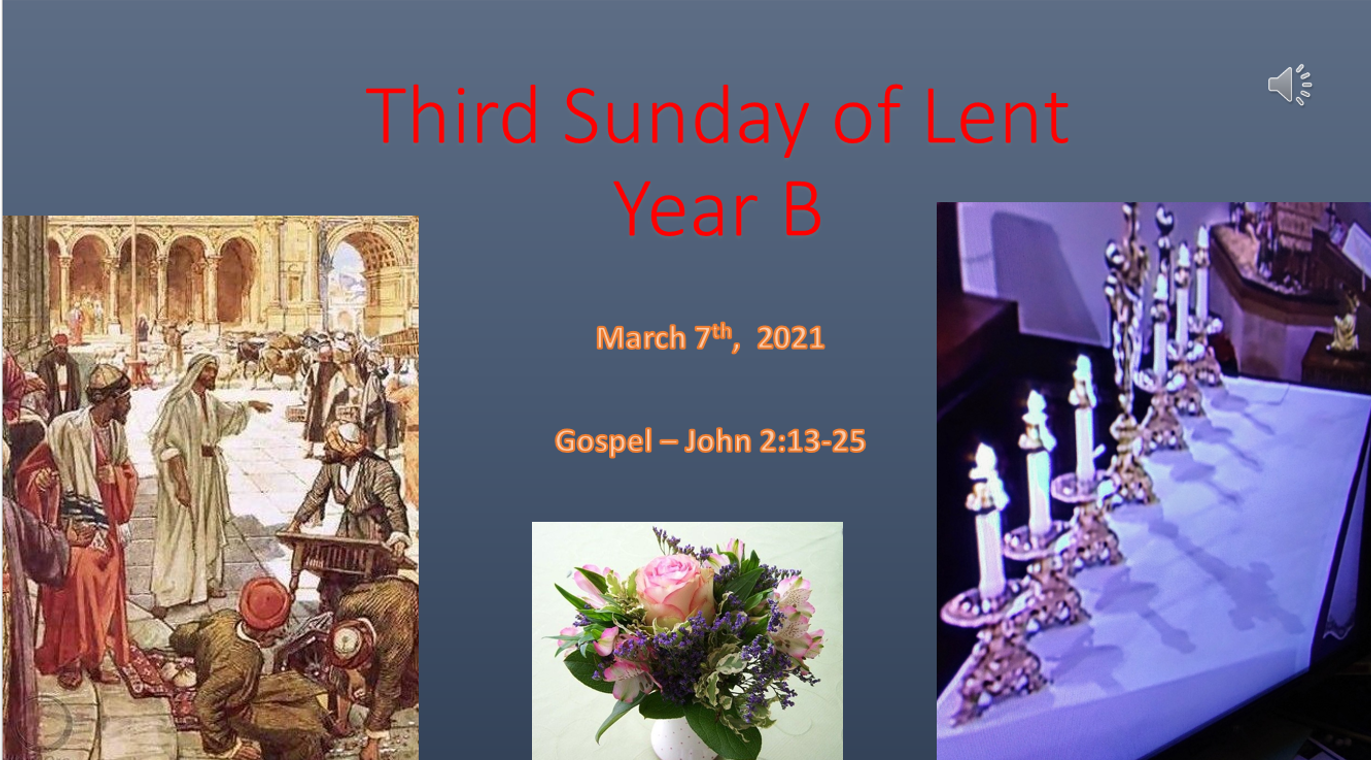
13 Since the Passover of the Jews was near, Jesus went up to Jerusalem.

14 He found in the temple area those who sold oxen, sheep, and doves, as well as the money changers seated there.

15 He made a whip out of cords and drove them all out of the temple area, with the sheep and oxen, and spilled the coins of the money changers and overturned their tables,

16 and to those who sold doves he said, “Take these out of here, and stop making my Father’s house a marketplace.”

17 His disciples recalled the words of Scripture

18 At this the Jews answered and said to him, “What sign can you show us for doing this?”

19 Jesus answered and said to them, “Destroy this temple and in three days I will raise it up.”

20 The Jews said, “This temple has been under construction for forty-six years, and you will raise it up in three days?”

21 But he was speaking about the temple of his body.

22 Therefore, when he was raised from the dead, his disciples remembered that he had said this, and they came to believe the Scripture and the word Jesus had spoken.

23 While he was in Jerusalem for the feast of Passover, many began to believe in his name when they saw the signs he was doing.

24 But Jesus would not trust himself to them because he knew them all,

25 and did not need anyone to testify about human nature. He himself understood it well.


Gospel For Third Sunday of Lent Year B

– John 2:13-25

In Nkwen

Àbòŋnǝ̀ Yesu Kristò ma Dzonə̀ Ŋwà’anǝ̀ â ŋwa’arǝ, 2:13-25

All: Mәkwu’utәnә̀ dzwi a mbwo wwò, o Nfò wìi.

Ma njwe nghwe bǝ Dzusǝ̀ kǝ kù’u la, Yesù ko’o nghǝ fǝfǝ Yerǝsalemǝ̀. A zǝ bǝ̀ ma bwô nunǝ fyanǝ bǝ̀ dzàkashì nǝ mbyi nǝ̀ bǝ̀sǝŋǝ nkǝ nkwǝbǝrǝ nkabǝ nǝbenǝ ndyâ-nywè nghwe.  A loo mǝ̀nkɛ̀rǝ̀ nghǝrǝ ngwànǝ̀ wu nti’i nsǝrǝ wwa nǝ zu, bwo bǝ̀ mbyi dzwu nǝ bǝ̀ dzàkashì, bwo lyǝtǝ ntsu ndyâ-nywe nghwe, nti’i nkǝ nkwirǝ nkabǝ̀ ngaŋǝ kwǝ̀bǝrǝ nkabǝ, nkâsǝ ǝ̀tǝ̌tǝ̀ jwa nkwusǝ nshyê, nti’i nwiŋǝ a mbwo ngaŋǝ fyanǝ bǝsǝŋǝ ngǝ, “Lo nə̀ nlyenǝ̀ nǝ bu fyî, nkə ndyâ Ətàa wa nǝ àdì’i mǝtanǝ bǝ ghǝ̀rǝ̂.” Ngaŋǝ ndzǝmǝ̀ jwi ti’i nwi’itǝ ma bǝ ŋwa’arǝ mǝmǝ̀ Aŋwà’àrǝ Ŋwà’ànǝ̀ ngǝ ə̀ləmt̀ə̀ ndyâ zhǝ bǝ zwɛrə wa. Əlya, bǝ Dzusə̀ ti’i mbiŋsǝ yi ngǝ, “Ə̀lensǝ̀ zu ma boŋǝ ò dǝ̌ nǝ̀ bìi mbǝ’ǝ anyu zi ma o ghǝ̀rǝ̀ li bǝ ǝ̀kǝ̀?” Yesù kwe nswiŋǝ nǝ bwo ngǝ, “Sà’àrǝnǝ̀ ndyâ-nywè nghwe zi mǝ̂ mbu nghwurǝ̀ nǝ njwe tarǝ. Bǝ Dzusə̀ swiŋǝ ngǝ, “Bǝ lô ǝ̀lùŋǝ̀ mǝ̀ghǝmǝ̀ nǝ̀kwà nǝ nchǝ̀ ntùu mǝ ghurǝnǝ̀ ndyâ-nywè nghwe zi, ò bǝ lo njwe tarǝ mǝ ghurǝ̀?” La ma Yesu kǝ bòŋnə̀ nlo a ǹnu zhi ma ndyâ-nywe nghwè.

A lyǝ nti’i mbǝ fǝ’ǝ̀ wu ma bǝ bǝŋsǝ yi nǝwwo la, ngaŋǝ ndzǝ̀mǝ̀ jwi ti’i nwi’itǝ ngǝ â bi ntɛ nswiŋǝ anyù zǐ. Bwo ti’i mbiŋǝ anyù zu ma Àŋwà’àrǝ̀ Ŋwà’ànǝ̀ swiŋǝ nǝ zu ma Yesu swiŋǝ. Ma bwo dzwi Yerǝsalemǝ̀ mǝ ǝjyǝ njwe nghwe la, bǝ̀ bâ nǝ̀nǝ̀ ti’i nzhitǝ mǝbiŋǝnǝ̀ nǝ ǝ̀lwenǝ̀ yɛ mbǝ’ǝma bwo zǝ ǝ̀khə̀’ə̀nǝ mǝ̀nyù mu ma â kǝ ghǝrǝ. La Yesù kâkǝ nnû zhì nu bwo ma’à mbǝ’ǝma â zhi wwa bǝtsǝ̀mǝ̀, kàkǝ ŋùdaŋǝ nswa’a ngǝ â biŋǝ nu mbǝ̀ zu ma ŋù dzwi mbǝ’ǝma zhǝ nǝ àtyembǝŋǝ zhi, zhi tsɛ’ɛ nshi’inǝ̌.

Àbòŋnǝ̀ Yesu Kristò.

All: Nghu’usǝ̀ dzwì a mbwo wwo Nfò Yesu Kristò.

Third Sunday of Lent, Year B

Free Translation

13 Since the Passover of the Jews was near, Jesus went up to Jerusalem. Ma njwe nghwe bǝ Dzusǝ̀ kǝ kù’u la, Yesù ko’o nghǝ fǝfǝ Yerǝsalemǝ̀.

14 He found in the temple area those who sold oxen, sheep, and doves, as well as the money changers seated there. A zǝ bǝ̀ ma bwô nunǝ fyanǝ bǝ̀ dzàkashì nǝ mbyi nǝ̀ bǝ̀sǝŋǝ nkǝ nkwǝbǝrǝ nkabǝ nǝbenǝ ndyâ-nywè nghwe.

15 He made a whip out of cords and drove them all out of the temple area, with the sheep and oxen, and spilled the coins of the money changers and overturned their tables, A loo mǝ̀nkɛ̀rǝ̀ nghǝrǝ ngwànǝ̀ wu nti’i nsǝrǝ wwa nǝ zu, bwo bǝ̀ mbyi dzwu nǝ bǝ̀ dzàkashì, bwo lyǝtǝ ntsu ndyâ-nywe nghwe, nti’i nkǝ nkwirǝ nkabǝ̀ ngaŋǝ kwǝ̀bǝrǝ nkabǝ, nkâsǝ ǝ̀tǝ̌tǝ̀ jwa nkwusǝ nshyê,

16 and to those who sold doves he said, “Take these out of here, and stop making my Father’s house a marketplace.” nti’i nwiŋǝ a mbwo ngaŋǝ fyanǝ bǝsǝŋǝ ngǝ, “Lo nə̀ nlyenǝ̀ nǝ bu fyî, nkə ndyâ Ətàa wa nǝ àdì’i mǝtanǝ bǝ ghǝ̀rǝ̂.”

17 His disciples recalled the words of Scripture, Zeal for your house will consume me. Ngaŋǝ ndzǝmǝ̀ jwi ti’i nwi’itǝ ma bǝ ŋwa’arǝ mǝmǝ̀ Aŋwà’àrǝ Ŋwà’ànǝ̀ ngǝ ə̀ləmt̀ə̀ ndyâ zhǝ bǝ zwɛrə wa.

18 At this the Jews answered and said to him, “What sign can you show us for doing this?” Əlya, bǝ Dzusə̀ ti’i mbiŋsǝ yi ngǝ, “Ə̀lensǝ̀ zu ma boŋǝ ò dǝ̌ nǝ̀ bìi mbǝ’ǝ anyu zi ma o ghǝ̀rǝ̀ li bǝ ǝ̀kǝ̀?”

19 Jesus answered and said to them, “Destroy this temple and in three days I will raise it up.” Yesù kwe nswiŋǝ nǝ bwo ngǝ, “Sà’àrǝnǝ̀ ndyâ-nywè nghwe zi mǝ̂ mbu nghwurǝ̀ nǝ njwe tarǝ.

20 The Jews said, “This temple has been under construction for forty-six years, and you will raise it up in three days?” Bǝ Dzusə̀ swiŋǝ ngǝ, “Bǝ lô ǝ̀lùŋǝ̀ mǝ̀ghǝmǝ̀ nǝ̀kwà nǝ nchǝ̀ ntùu mǝ ghurǝnǝ̀ ndyâ-nywè nghwe zi, ò bǝ lo njwe tarǝ mǝ ghurǝ̀?”

21 But he was speaking about the temple of his body. La ma Yesu kǝ bòŋnə̀ nlo a ǹnu zhi ma ndyâ-nywe nghwè.

22 Therefore, when he was raised from the dead, his disciples remembered that he had said this, and they came to believe the Scripture and the word Jesus had spoken. A lyǝ nti’i mbǝ fǝ’ǝ̀ wu ma bǝ bǝŋsǝ yi nǝwwo la, ngaŋǝ ndzǝ̀mǝ̀ jwi ti’i nwi’itǝ ngǝ â bi ntɛ nswiŋǝ anyù zǐ. Bwo ti’i mbiŋǝ anyù zu ma Àŋwà’àrǝ̀ Ŋwà’ànǝ̀ swiŋǝ nǝ zu ma Yesu swiŋǝ.

23 While he was in Jerusalem for the feast of Passover, many began to believe in his name when they saw the signs he was doing. Ma bwo dzwi Yerǝsalemǝ̀ mǝ ǝjyǝ njwe nghwe la, bǝ̀ bâ nǝ̀nǝ̀ ti’i nzhitǝ mǝbiŋǝnǝ̀ nǝ ǝ̀lwenǝ̀ yɛ mbǝ’ǝma bwo zǝ ǝ̀khə̀’ə̀nǝ mǝ̀nyù mu ma â kǝ ghǝrǝ.

24 But Jesus would not trust himself to them because he knew them all, La Yesù kâkǝ nnû zhì nu bwo ma’à mbǝ’ǝma â zhi wwa bǝtsǝ̀mǝ̀,

25 and did not need anyone to testify about human nature. He himself understood it well. kàkǝ ŋùdaŋǝ nswa’a ngǝ â biŋǝ nu mbǝ̀ zu ma ŋù dzwi mbǝ’ǝma zhǝ nǝ àtyembǝŋǝ zhi, zhi tsɛ’ɛ nshi’inǝ̌.

Related posts:

Nkwen Language Gospel Readings For Year B

Poems About Life

Responsorial Psalm Chants For Sundays
Nkwen Language Lessons

Basic Mathematics

Inspired Writings

Home

Third Sunday of Lent, Year B Gospel – John 2:13-25

Gospel – John 2:13-25

https://youtu.be/gTrI00o7tz4

13 Since the Passover of the Jews was near, Jesus went up to Jerusalem.

14 He found in the temple area those who sold oxen, sheep, and doves, as well as the money changers seated there.

15 He made a whip out of cords and drove them all out of the temple area, with the sheep and oxen, and spilled the coins of the money changers and overturned their tables,

16 and to those who sold doves he said, “Take these out of here, and stop making my Father’s house a marketplace.”

17 His disciples recalled the words of Scripture

18 At this the Jews answered and said to him, “What sign can you show us for doing this?”

19 Jesus answered and said to them, “Destroy this temple and in three days I will raise it up.”

20 The Jews said, “This temple has been under construction for forty-six years, and you will raise it up in three days?”

21 But he was speaking about the temple of his body.

22 Therefore, when he was raised from the dead, his disciples remembered that he had said this, and they came to believe the Scripture and the word Jesus had spoken.

23 While he was in Jerusalem for the feast of Passover, many began to believe in his name when they saw the signs he was doing.

24 But Jesus would not trust himself to them because he knew them all,

25 and did not need anyone to testify about human nature. He himself understood it well.

In Nkwen

Àbòŋnǝ̀ Yesu Kristò ma Dzonə̀ Ŋwà’anǝ̀ â ŋwa’arǝ, 2:13-25

All: Mәkwu’utәnә̀ dzwi a mbwo wwò, o Nfò wìi.

Ma njwe nghwe bǝ Dzusǝ̀ kǝ kù’u la, Yesù ko’o nghǝ fǝfǝ Yerǝsalemǝ̀. A zǝ bǝ̀ ma bwô nunǝ fyanǝ bǝ̀ dzàkashì nǝ mbyi nǝ̀ bǝ̀sǝŋǝ nkǝ nkwǝbǝrǝ nkabǝ nǝbenǝ ndyâ-nywè nghwe.  A loo mǝ̀nkɛ̀rǝ̀ nghǝrǝ ngwànǝ̀ wu nti’i nsǝrǝ wwa nǝ zu, bwo bǝ̀ mbyi dzwu nǝ bǝ̀ dzàkashì, bwo lyǝtǝ ntsu ndyâ-nywe nghwe, nti’i nkǝ nkwirǝ nkabǝ̀ ngaŋǝ kwǝ̀bǝrǝ nkabǝ, nkâsǝ ǝ̀tǝ̌tǝ̀ jwa nkwusǝ nshyê, nti’i nwiŋǝ a mbwo ngaŋǝ fyanǝ bǝsǝŋǝ ngǝ, “Lo nə̀ nlyenǝ̀ nǝ bu fyî, nkə ndyâ Ətàa wa nǝ àdì’i mǝtanǝ bǝ ghǝ̀rǝ̂.” Ngaŋǝ ndzǝmǝ̀ jwi ti’i nwi’itǝ ma bǝ ŋwa’arǝ mǝmǝ̀ Aŋwà’àrǝ Ŋwà’ànǝ̀ ngǝ ə̀ləmt̀ə̀ ndyâ zhǝ bǝ zwɛrə wa. Əlya, bǝ Dzusə̀ ti’i mbiŋsǝ yi ngǝ, “Ə̀lensǝ̀ zu ma boŋǝ ò dǝ̌ nǝ̀ bìi mbǝ’ǝ anyu zi ma o ghǝ̀rǝ̀ li bǝ ǝ̀kǝ̀?” Yesù kwe nswiŋǝ nǝ bwo ngǝ, “Sà’àrǝnǝ̀ ndyâ-nywè nghwe zi mǝ̂ mbu nghwurǝ̀ nǝ njwe tarǝ. Bǝ Dzusə̀ swiŋǝ ngǝ, “Bǝ lô ǝ̀lùŋǝ̀ mǝ̀ghǝmǝ̀ nǝ̀kwà nǝ nchǝ̀ ntùu mǝ ghurǝnǝ̀ ndyâ-nywè nghwe zi, ò bǝ lo njwe tarǝ mǝ ghurǝ̀?” La ma Yesu kǝ bòŋnə̀ nlo a ǹnu zhi ma ndyâ-nywe nghwè.

A lyǝ nti’i mbǝ fǝ’ǝ̀ wu ma bǝ bǝŋsǝ yi nǝwwo la, ngaŋǝ ndzǝ̀mǝ̀ jwi ti’i nwi’itǝ ngǝ â bi ntɛ nswiŋǝ anyù zǐ. Bwo ti’i mbiŋǝ anyù zu ma Àŋwà’àrǝ̀ Ŋwà’ànǝ̀ swiŋǝ nǝ zu ma Yesu swiŋǝ. Ma bwo dzwi Yerǝsalemǝ̀ mǝ ǝjyǝ njwe nghwe la, bǝ̀ bâ nǝ̀nǝ̀ ti’i nzhitǝ mǝbiŋǝnǝ̀ nǝ ǝ̀lwenǝ̀ yɛ mbǝ’ǝma bwo zǝ ǝ̀khə̀’ə̀nǝ mǝ̀nyù mu ma â kǝ ghǝrǝ. La Yesù kâkǝ nnû zhì nu bwo ma’à mbǝ’ǝma â zhi wwa bǝtsǝ̀mǝ̀, kàkǝ ŋùdaŋǝ nswa’a ngǝ â biŋǝ nu mbǝ̀ zu ma ŋù dzwi mbǝ’ǝma zhǝ nǝ àtyembǝŋǝ zhi, zhi tsɛ’ɛ nshi’inǝ̌.

Àbòŋnǝ̀ Yesu Kristò.

All: Nghu’usǝ̀ dzwì a mbwo wwo Nfò Yesu Kristò.

Free Translation

13 Since the Passover of the Jews was near, Jesus went up to Jerusalem. Ma njwe nghwe bǝ Dzusǝ̀ kǝ kù’u la, Yesù ko’o nghǝ fǝfǝ Yerǝsalemǝ̀.

14 He found in the temple area those who sold oxen, sheep, and doves, as well as the money changers seated there. A zǝ bǝ̀ ma bwô nunǝ fyanǝ bǝ̀ dzàkashì nǝ mbyi nǝ̀ bǝ̀sǝŋǝ nkǝ nkwǝbǝrǝ nkabǝ nǝbenǝ ndyâ-nywè nghwe.

15 He made a whip out of cords and drove them all out of the temple area, with the sheep and oxen, and spilled the coins of the money changers and overturned their tables, A loo mǝ̀nkɛ̀rǝ̀ nghǝrǝ ngwànǝ̀ wu nti’i nsǝrǝ wwa nǝ zu, bwo bǝ̀ mbyi dzwu nǝ bǝ̀ dzàkashì, bwo lyǝtǝ ntsu ndyâ-nywe nghwe, nti’i nkǝ nkwirǝ nkabǝ̀ ngaŋǝ kwǝ̀bǝrǝ nkabǝ, nkâsǝ ǝ̀tǝ̌tǝ̀ jwa nkwusǝ nshyê,

16 and to those who sold doves he said, “Take these out of here, and stop making my Father’s house a marketplace.” nti’i nwiŋǝ a mbwo ngaŋǝ fyanǝ bǝsǝŋǝ ngǝ, “Lo nə̀ nlyenǝ̀ nǝ bu fyî, nkə ndyâ Ətàa wa nǝ àdì’i mǝtanǝ bǝ ghǝ̀rǝ̂.”

17 His disciples recalled the words of Scripture, Zeal for your house will consume me. Ngaŋǝ ndzǝmǝ̀ jwi ti’i nwi’itǝ ma bǝ ŋwa’arǝ mǝmǝ̀ Aŋwà’àrǝ Ŋwà’ànǝ̀ ngǝ ə̀ləmt̀ə̀ ndyâ zhǝ bǝ zwɛrə wa.

18 At this the Jews answered and said to him, “What sign can you show us for doing this?” Əlya, bǝ Dzusə̀ ti’i mbiŋsǝ yi ngǝ, “Ə̀lensǝ̀ zu ma boŋǝ ò dǝ̌ nǝ̀ bìi mbǝ’ǝ anyu zi ma o ghǝ̀rǝ̀ li bǝ ǝ̀kǝ̀?”

19 Jesus answered and said to them, “Destroy this temple and in three days I will raise it up.” Yesù kwe nswiŋǝ nǝ bwo ngǝ, “Sà’àrǝnǝ̀ ndyâ-nywè nghwe zi mǝ̂ mbu nghwurǝ̀ nǝ njwe tarǝ.

20 The Jews said, “This temple has been under construction for forty-six years, and you will raise it up in three days?” Bǝ Dzusə̀ swiŋǝ ngǝ, “Bǝ lô ǝ̀lùŋǝ̀ mǝ̀ghǝmǝ̀ nǝ̀kwà nǝ nchǝ̀ ntùu mǝ ghurǝnǝ̀ ndyâ-nywè nghwe zi, ò bǝ lo njwe tarǝ mǝ ghurǝ̀?”

21 But he was speaking about the temple of his body. La ma Yesu kǝ bòŋnə̀ nlo a ǹnu zhi ma ndyâ-nywe nghwè.

22 Therefore, when he was raised from the dead, his disciples remembered that he had said this, and they came to believe the Scripture and the word Jesus had spoken. A lyǝ nti’i mbǝ fǝ’ǝ̀ wu ma bǝ bǝŋsǝ yi nǝwwo la, ngaŋǝ ndzǝ̀mǝ̀ jwi ti’i nwi’itǝ ngǝ â bi ntɛ nswiŋǝ anyù zǐ. Bwo ti’i mbiŋǝ anyù zu ma Àŋwà’àrǝ̀ Ŋwà’ànǝ̀ swiŋǝ nǝ zu ma Yesu swiŋǝ.

23 While he was in Jerusalem for the feast of Passover, many began to believe in his name when they saw the signs he was doing. Ma bwo dzwi Yerǝsalemǝ̀ mǝ ǝjyǝ njwe nghwe la, bǝ̀ bâ nǝ̀nǝ̀ ti’i nzhitǝ mǝbiŋǝnǝ̀ nǝ ǝ̀lwenǝ̀ yɛ mbǝ’ǝma bwo zǝ ǝ̀khə̀’ə̀nǝ mǝ̀nyù mu ma â kǝ ghǝrǝ.

24 But Jesus would not trust himself to them because he knew them all, La Yesù kâkǝ nnû zhì nu bwo ma’à mbǝ’ǝma â zhi wwa bǝtsǝ̀mǝ̀,

25 and did not need anyone to testify about human nature. He himself understood it well. kàkǝ ŋùdaŋǝ nswa’a ngǝ â biŋǝ nu mbǝ̀ zu ma ŋù dzwi mbǝ’ǝma zhǝ nǝ àtyembǝŋǝ zhi, zhi tsɛ’ɛ nshi’inǝ̌.

Click on the link below to go to related pages.

Nkwen Language Gospel Readings For Year B

Aspects Of The English Language

General Knowledge Questions and Answers Revision

Poems About Life

Responsorial Psalm Chants For Sundays

Nkwen Language Lessons

Basic Mathematics

Inspired Writings

Nkwen Language Gospel Readings

Home

NKWEN LANGUAGE LESSONS Greetings, family, Alphabet, Tone Marks, Numbers

Nkwen language Lessons
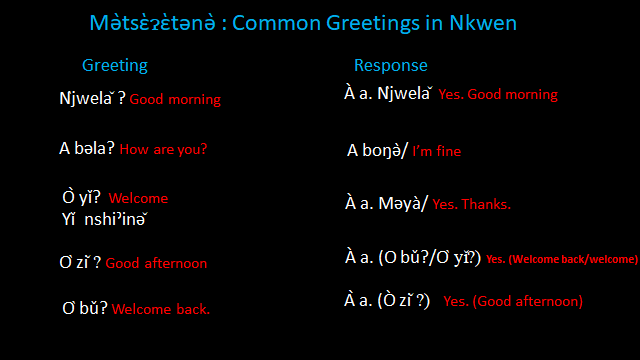
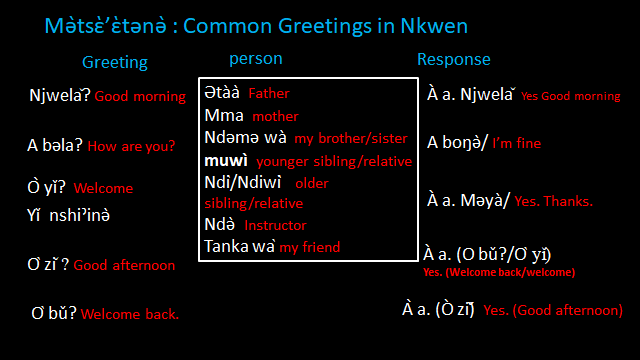
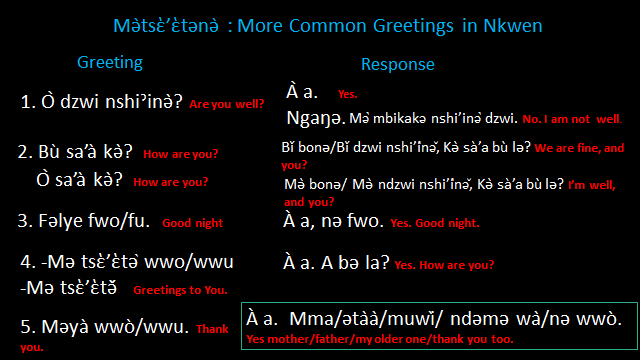
Nkwen Language common Greetings and Responses 

Nkwen Language Lessons
Get the Nkwen Language Podcast here.
Mǝ̀tsɛ̀’ɛ̀tǝnǝ̀ – Greetings

Greetings in Nkwen Language

Common greetings in Nkwen Language
Nkwen Language common Greetings and Responses 

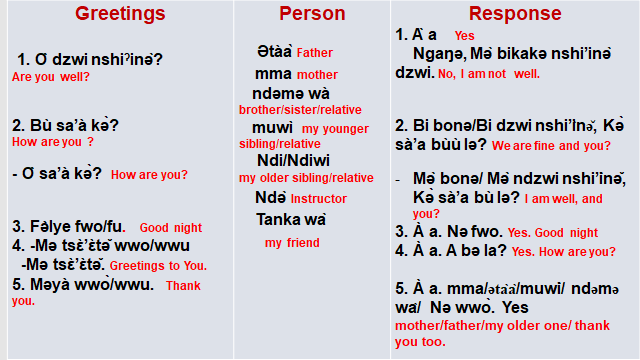
More on greetings in Nkwen Language

Greetings in Nkwen Language
More on greetings in Nkwen Language
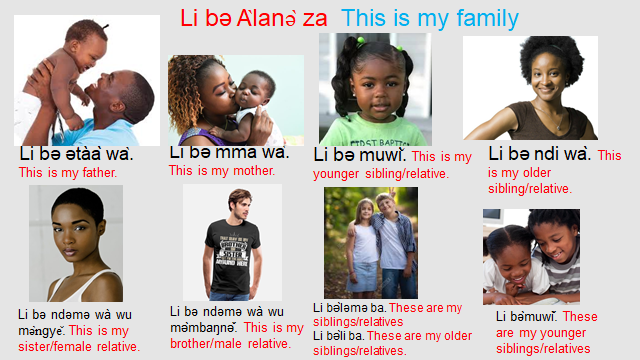
Nkwen Language ;  The Family 

My Family – Àlanǝ̀ za 

Get the Nkwen Language Podcast here.

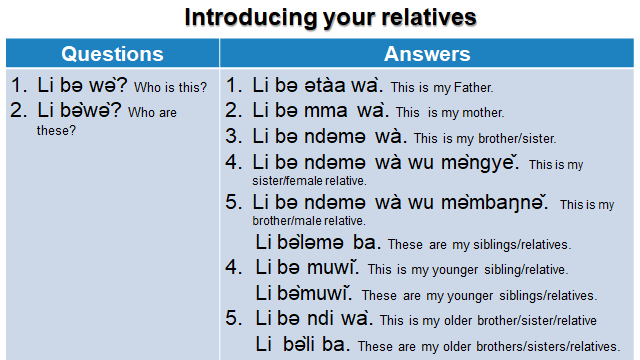
Nkwen Language Introducing The Family
Nkwen Language Family 

Nkwen Language Introducing relatives or siblings

  https://youtube.com/c/TaminangThereseN

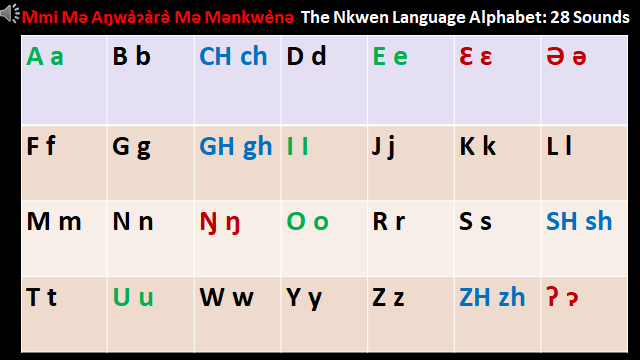
The Nkwen Language AlphabetM̀mi Mǝ Aŋwà’àrǝ̀ Mǝ Mǝnkwènǝ

Nkwen Language Alphabet
Nkwen Language Aplhabet https://youtu.be/khn6uSV4QS0

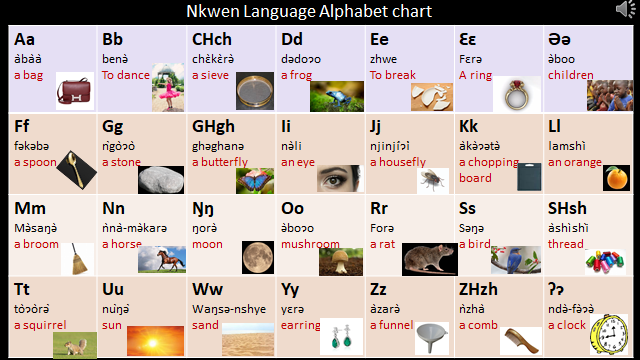
Nkwen Language Alphabet Chart
Nkwen Language Aplhabet 

Nkwen Language Alphabet

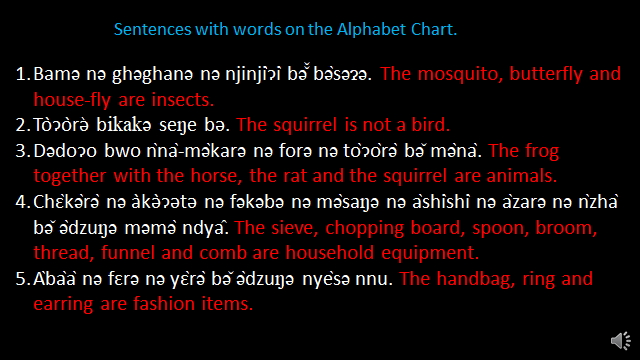
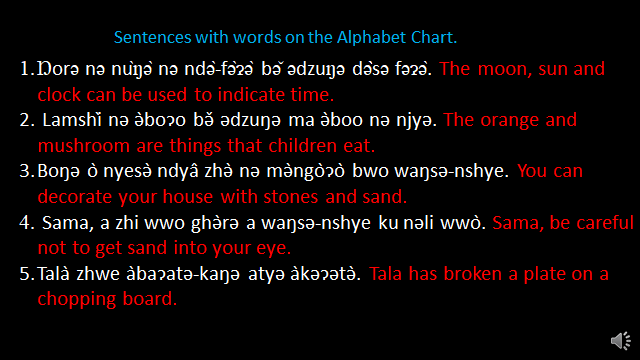
Sentences with words on the Nkwen Language Alphabet
Nkwen Language Alphabet 

Nkwen Language Alphabet
Sentences with words on the Nkwen Language Alphabet
The Nkwen Language Alphabet

Get the Nkwen Language Podcast here.
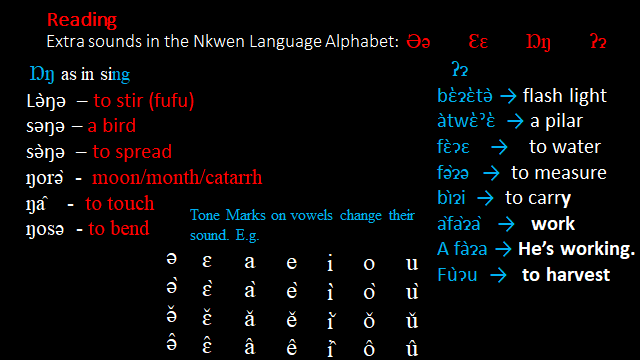
Extra sounds in Nkwen Alphabet not directly found in the English Alphabet

TNkwen Language Alphabet Extra Sounds
Nkwen Language Alphabet Extra Sounds
Nkwen Language Extra sounds ǝ,ɛ, ŋ, ɂ, 

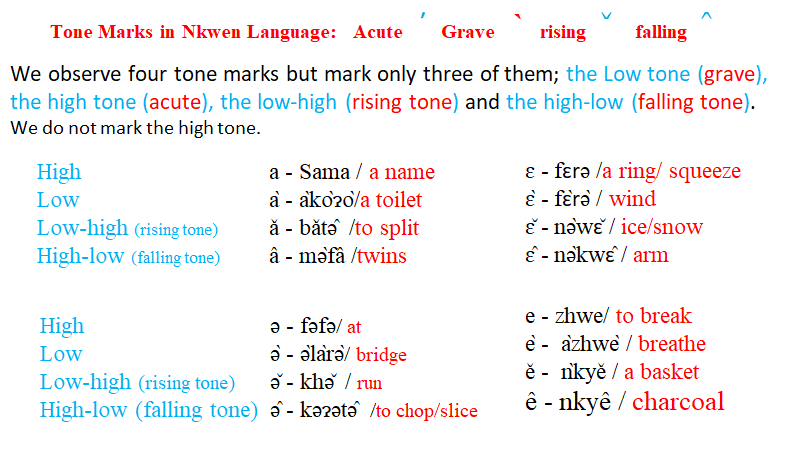
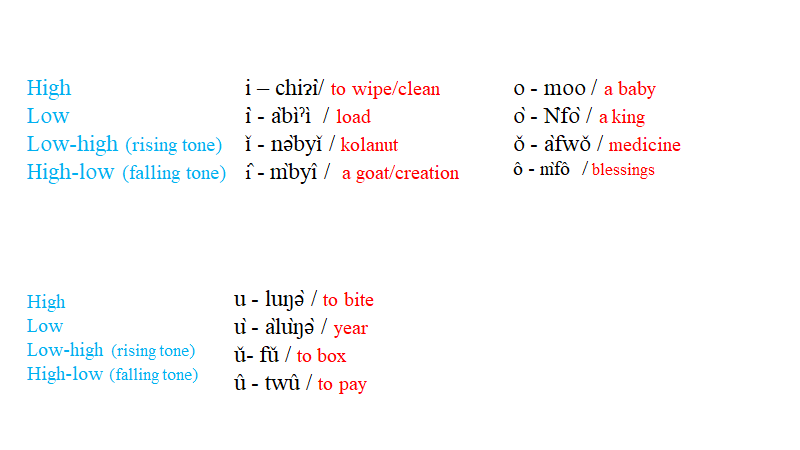
Nkwen Language Tone Marks
Tone Marks in Nkwen Language

Nkwen Language Tone Marks

Tone Marks in Nkwen Language

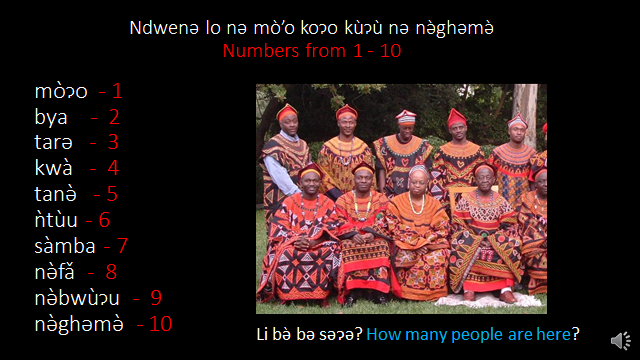
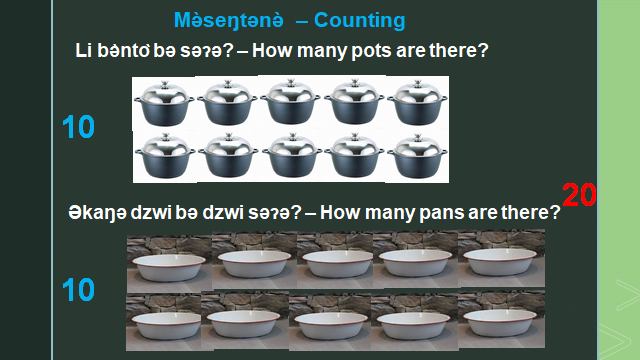
Counting – Mә̀seŋtәnә̀ 

Nkwen Language counting
Nkwen Language Numbers 

Nkwen Language Numbers
Nkwen Language Numbers 

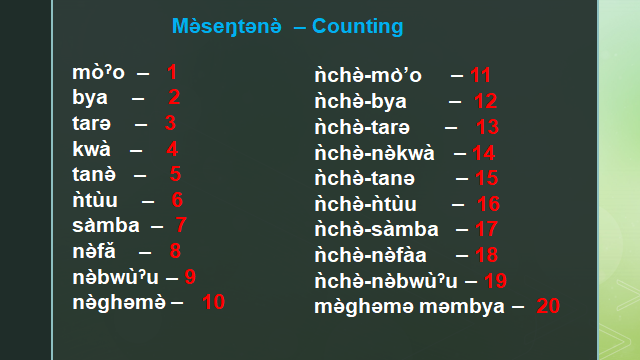
Nkwen Language Numbers 1 to 20
Numbers in Nkwen Language 1 to 20


Nkwen Language Numbers 1 -20 

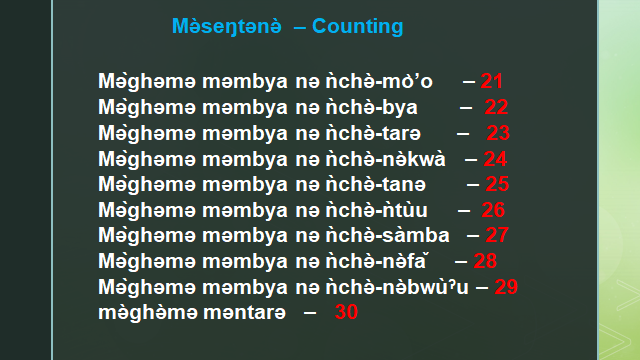
Nkwen Language Numbers 21 to 30
Numbers in Nkwen Language 21 to 30 Nkwen Language Numbers 21 -30 


Nkwen Language Numbers
Numbers in Nkwen Language
Nkwen Language Numbers 

Nkwen Language Numbers 31 to 40
Numbers in Nkwen Language 31 to 40
Nkwen Language Numbers 31 -40 

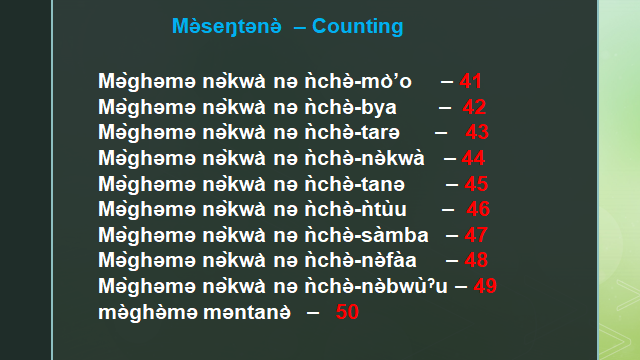
Nkwen Language Numbers 41 to 50
Numbers in Nkwen Language 41 to 50
Nkwen Language Numbers 41 -50 

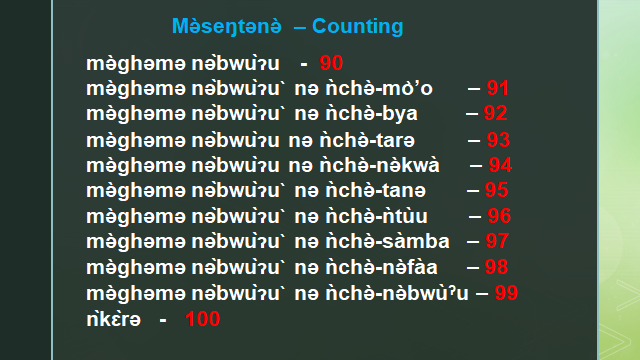
Nkwen Language Numbers 91 to 100
Numbers in Nkwen Language 91 to 100
Nkwen Language Numbers 90 -100 on Youtube

Get the Nkwen Language Podcast here.

Second Sunday of Lent, Year B Psalm, Gospel And Acclamation

Second Sunday of Lent, Year B

Responsorial Psalm for Second Sunday of Lent, Year B

– Psalms 116:10, 15, 16-17, 18-19

R. (116:9) I will walk before the Lord, in the land of the living.

10 I believed, even when I said,
“I am greatly afflicted.”
15 Precious in the eyes of the LORD
is the death of his faithful ones.
R. I will walk before the Lord, in the land of the living.

16 O LORD, I am your servant;
I am your servant, the son of your handmaid;
you have loosed my bonds.
17 To you will I offer sacrifice of thanksgiving,
and I will call upon the name of the LORD.
R. I will walk before the Lord, in the land of the living.


18 My vows to the LORD I will pay
in the presence of all his people,
19 In the courts of the house of the LORD,
in your midst, O Jerusalem.
R. I will walk before the Lord, in the land of the living.

Verse Before The Gospel For Second Sunday of Lent, Year B

– Matthew 17:5

5 From the shining cloud the Father’s voice is heard:
This is my beloved Son, listen to him.

Gospel For Second Sunday of Lent, Year B

– Mark 9:2-10

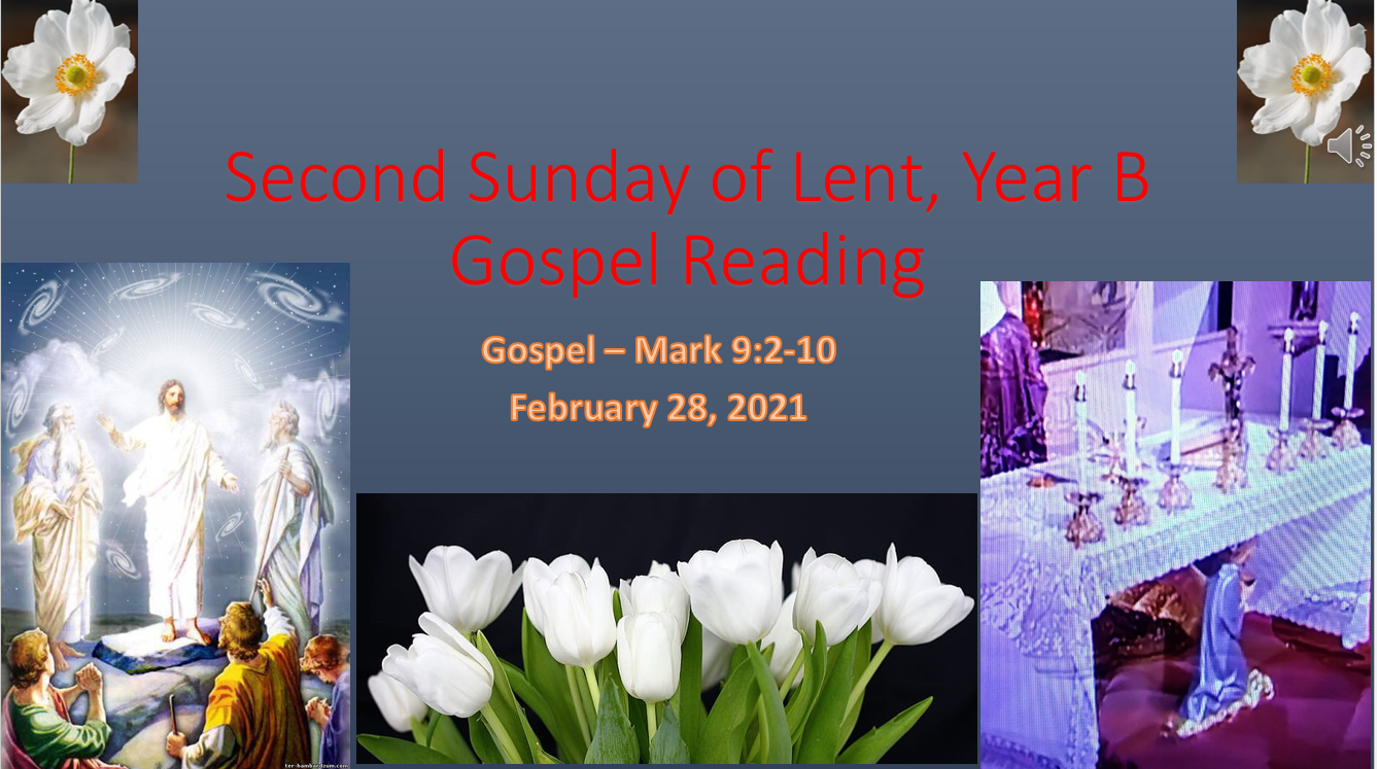
2 Jesus took Peter, James, and John and led them up a high mountain apart by themselves. And he was transfigured before them,

3 and his clothes became dazzling white, such as no fuller on earth could bleach them.

4 Then Elijah appeared to them along with Moses, and they were conversing with Jesus.

5 Then Peter said to Jesus in reply, “Rabbi, it is good that we are here! Let us make three tents: one for you, one for Moses, and one for Elijah.” 6 He hardly knew what to say, they were so terrified.

7 Then a cloud came, casting a shadow over them; from the cloud came a voice, “This is my beloved Son. Listen to him

8 Suddenly, looking around, they no longer saw anyone but Jesus alone with them.

9 As they were coming down from the mountain, he charged them not to relate what they had seen to anyone, except when the Son of Man had risen from the dead.

10  So they kept the matter to themselves, questioning what rising from the dead meant.

In Nkwen Language – Second Sunday of Lent, Year B Gospel in Nkwen

Playlist on YouTube

Àbòŋnǝ̀ Yesu Kristò ma  Marәkùs  Ŋwà’anǝ̀ â ŋwa’arǝ, 9:2-10

All: Mәkwu’utәnә̀ dzwi a mbwo wwò, o Nfò wìi.       

Yesù lo Bità nǝ Dzemsǝ̀ nǝ Dzonǝ̀ bwo ko’o nghǝ atyǝ̂ shà mba tsǝ̀ tsuŋǝ bwo bwô. Bǝ ti’i nghǝrǝ ǝ̀khǝ̀’ǝ zhi kwǝbǝrǝ̀ nshi bwo. Ə̀tsǝ̀’ǝ jwi ti’i nfǝbǝ nwankǝ̂ titi ma boŋǝ nsǔ-ǝtsǝ̀’ǝ daŋǝ nshye wi kàkǝ̌ sǔ.  Elayidzà bwo Mose ti’i nfune nu bwo, bwo bǝ̀ Yesù ti’i m̀bòŋnǝ̌. Bità ti’i nswiŋǝ a mbwo Yesù ngǝ, “Rabayì, a boŋǝ ngǝ binǝ̀ dzwi fǐ, a bi ghwurǝ mǝntàŋǝ̀ mǝntarǝ: wi mo’o mbwo wwò, wi mo’o mbwo Mose nǝ wi mo’o a mbwo Èlayidzà. Àswerǝ̀ ti’i ngaŋǝ wwa titì a kakǝ anyu dàŋǝ̀ bu zhi mǝswiŋnǝ̀.

Mbà’à tsǝ̀ ti’i nyii mbùŋǝ̀ wwa, njì tsǝ̀ fu mǝmǝ mbà’à wu nswiŋǝ ngǝ, “Li bǝ moo wà ma mǝ̀ koŋǝ susu, a bù zu’u a mbwo zhǝ.” Tsuŋǝ fǝ̀bàŋtǝ̀ li bwo ti’ì mbu li ǝdi’i nkarǝsǝ nti’i nzǝ tsuŋǝ̀ Yesù zhǝzhǝ kàkǝ wwa ŋu dàŋǝ̀ bu zǝ.

Ma bwô lyǝ atyǝ nta’a nti’i ntsô la, Yesù kwantǝ̀ wwa ngǝ a bwo kǝ anyù zu ma bwo zə a mbwo ŋùdàŋǝ nǝ swiŋǝ, la nlyǝ nswiŋǝ tsɛ’ɛ a fǝ’ǝ̀ wu ma Moo Ŋù̀ lyǝ tɛ bǝ̀ŋnǝ̀ nǝwwo. Bwo ti’i nliŋǝ anyù zi atətə̌ bwo la mbiŋsǝ àtyembə̀ŋə̀ zha ngǝ mǝ̀bǝ̀ŋnǝnǝ̀ nǝwwo bǝ li ngǝ kǝ̀ lǝ.

Àbòŋnǝ̀ Yesu Kristò.

All: Nghu’usǝ̀ dzwì a mbwo wwo Nfò Yesu Kristò.

Free Translation

2 Jesus took Peter, James, and John and led them up a high mountain apart by themselves. And he was transfigured before them, Yesù lo Bità nǝ Dzemsǝ̀ nǝ Dzonǝ̀ bwo ko’o nghǝ atyǝ̂ shà mba tsǝ̀ tsuŋǝ bwo bwô. Bǝ ti’i nghǝrǝ ǝ̀khǝ̀’ǝ zhi kwǝbǝrǝ̀ nshi bwo.

3 and his clothes became dazzling white, such as no fuller on earth could bleach them. Ə̀tsǝ̀’ǝ jwi ti’i nfǝbǝ nwankǝ̂ titi ma boŋǝ nsǔ-ǝtsǝ̀’ǝ daŋǝ nshye wi kàkǝ̌ sǔ. 

4 Then Elijah appeared to them along with Moses, and they were conversing with Jesus. Elayidzà bwo Mose ti’i nfune nu bwo, bwo bǝ̀ Yesù ti’i m̀bòŋnǝ̌.

5 Then Peter said to Jesus in reply, “Rabbi, it is good that we are here! Let us make three tents: one for you, one for Moses, and one for Elijah.” Bità ti’i nswiŋǝ a mbwo Yesù ngǝ, “Rabayì, a boŋǝ ngǝ binǝ̀ dzwi fǐ, a bi ghwurǝ mǝntàŋǝ̀ mǝntarǝ: wi mo’o mbwo wwò, wi mo’o mbwo Mose nǝ wi mo’o a mbwo Èlayidzà.

6 He hardly knew what to say, they were so terrified. Àswerǝ̀ ti’i ngaŋǝ wwa titì a kakǝ anyu dàŋǝ̀ bu zhi mǝswiŋnǝ̀.

7 Then a cloud came, casting a shadow over them; from the cloud came a voice, “This is my beloved Son. Listen to him.” Mbà’à tsǝ̀ ti’i nyii mbùŋǝ̀ wwa, njì tsǝ̀ fu mǝmǝ mbà’à wu nswiŋǝ ngǝ, “Li bǝ moo wà ma mǝ̀ koŋǝ susu, a bù zu’u a mbwo zhǝ.”

8 Suddenly, looking around, they no longer saw anyone but Jesus alone with them. Tsuŋǝ fǝ̀bàŋtǝ̀ li bwo ti’ì mbu li ǝdi’i nkarǝsǝ nti’i nzǝ tsuŋǝ̀ Yesù zhǝzhǝ kàkǝ wwa ŋu dàŋǝ̀ bu zǝ.

9 As they were coming down from the mountain, he charged them not to relate what they had seen to anyone, except when the Son of Man had risen from the dead. Ma bwô lyǝ atyǝ nta’a nti’i ntsô la, Yesù kwantǝ̀ wwa ngǝ a bwo kǝ anyù zu ma bwo zə a mbwo ŋùdàŋǝ nǝ swiŋǝ, la nlyǝ nswiŋǝ tsɛ’ɛ a fǝ’ǝ̀ wu ma Moo Ŋù lyǝ tɛ bǝ̀ŋnǝ̀ nǝwwo.

 
Second Sunday of Lent, Year B 

Nkwen Language Gospel Readings For Year B

Responsorial Psalm Chants For Sundays

Inspired Writings

Nkwen Language Gospel Readings

Home