The /ch/ sound in Nkwen Language

Advertisements

CH ch

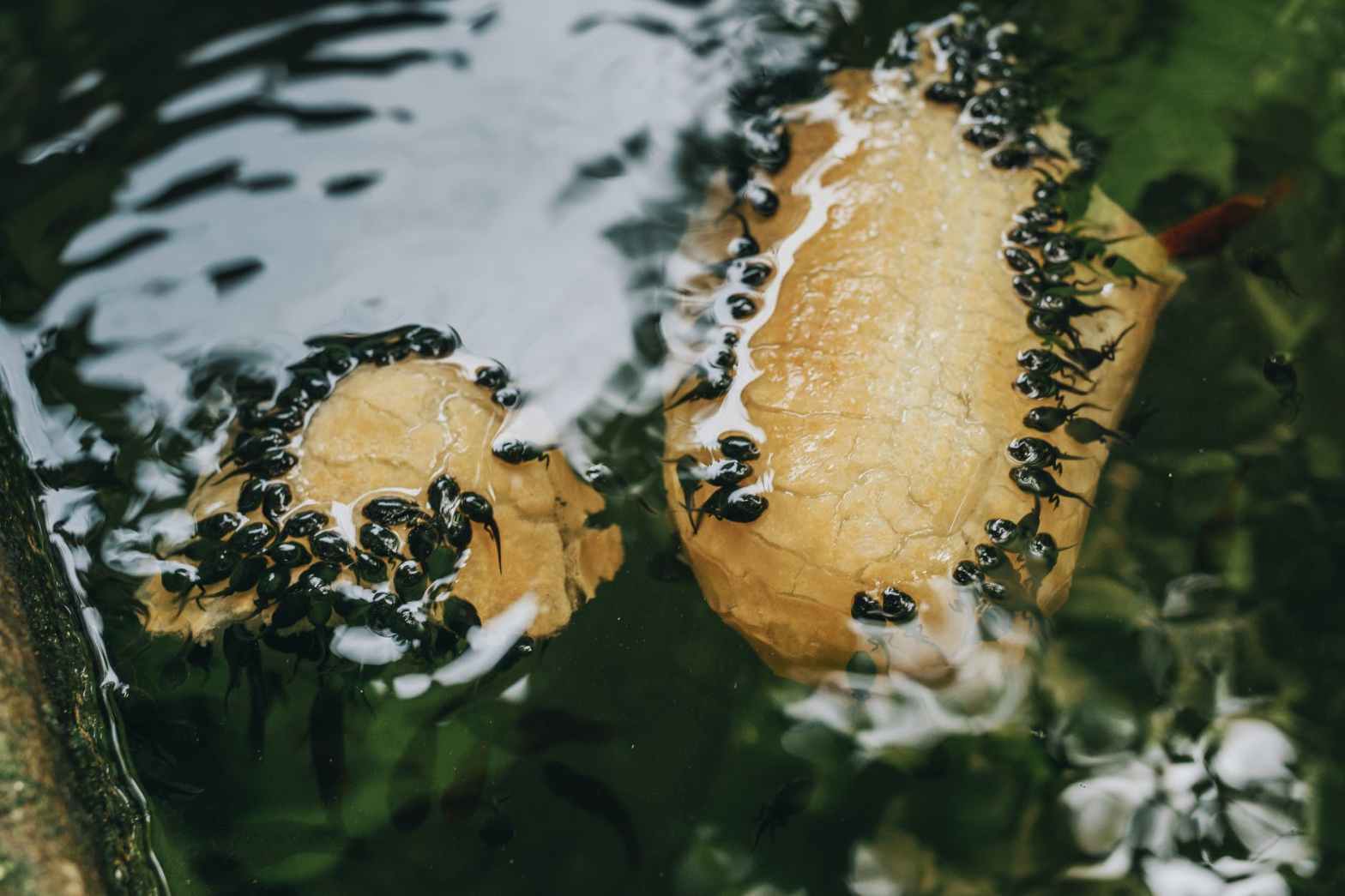
chichi’i → a tadpole

Nkwen Language lessons https://www.youtube.com/watch?v=hUxKr8OnLBI&list=PL_ihUsy6_PLIGXM9vFSgIaP5EP1vbDokZ
Advertisements

This sound /ch/ is a double consonant sound in Nkwen Language. /Ch/ features more often in the initial and medial positions in some words. It doesn’t come at the final position.

CH ch

Chә̀nywe → a name (m)

chyǎ →. to pass

chyàsә̂ → to send/to give way

chuwa → to clear

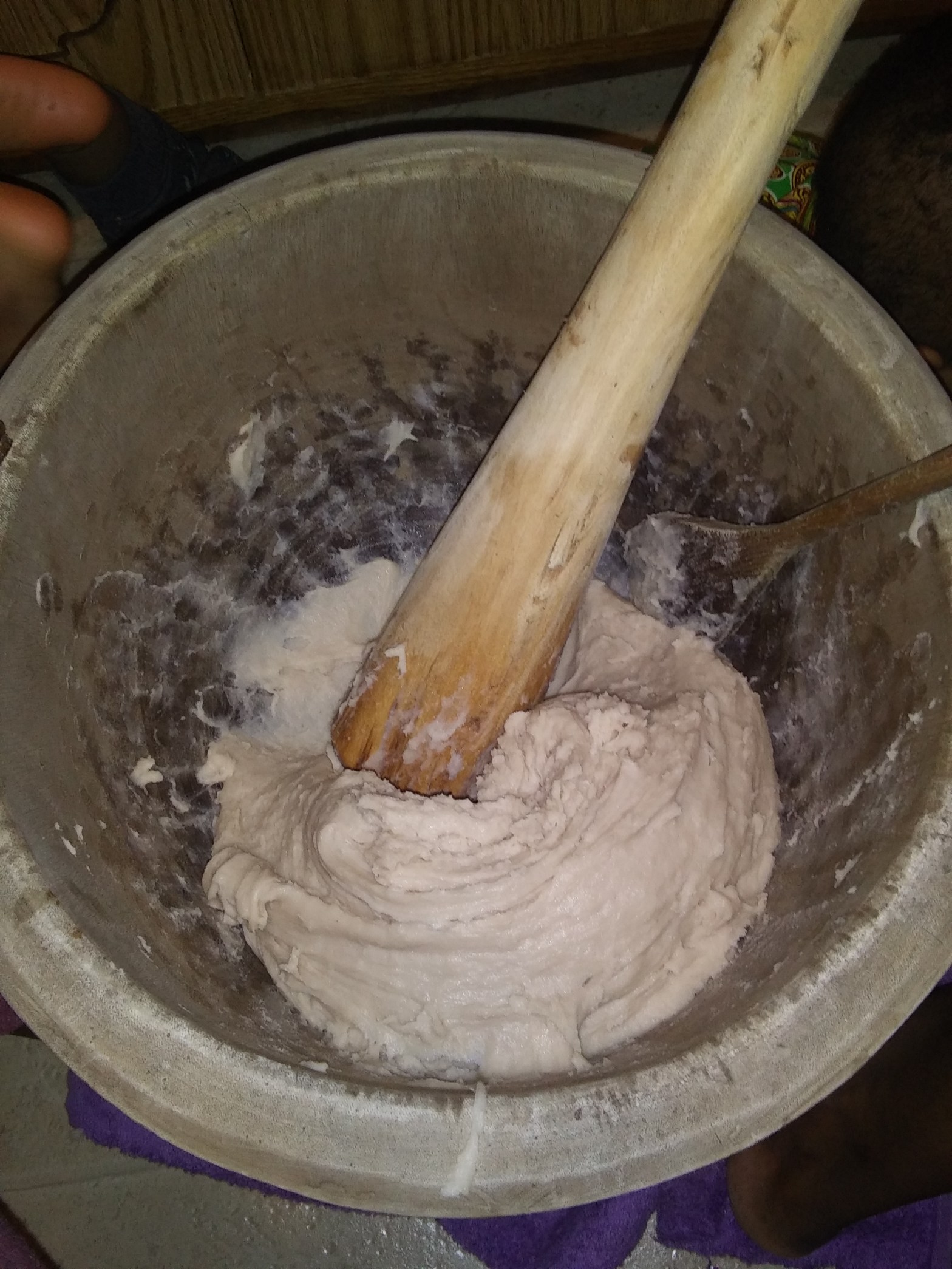
chuˀu → to pound

chùu → to soak

chì’i → to shake

chi’i → to cancel

chi’isǝ̂! → Cancel!

Advertisements

chichi’i → a tadpole

chǝ̌ → a wild animal

chǐ → father-in-law

ànchinǝ̌ → a cricket

chǝ̀ → injunction

chù’u → a thousand

chìchì → a frightful thing

àchi’ìnә̌ → strong grass (guinea savannah type)

Advertisements

Mә̀toŋtәnә̀ – Reading

Chә̀nywe à chwa ǹsùŋә yε. À bә tsoˀotә achiˀìnә̀ nә àso zhi. À bә tsùˀu tiˀi әliˀi әwὲε mәjyә mi wә. Ǹchǐ yî bǝ yìi kwesǝ yɛ. À chǔ ngwàsaŋә bwo mә̀kû ma a bә wὲὲ wε. Ànchinә̀ toŋә̀ ngorә̀ yi nsuŋә zhә. Ə bә lyâ fu kwùrә mәnjyә yε.

Free Translation
Chenwie has cleared his farm. He will remove the strong grass with his hoe. After tilling and preparing, he will plant his crops. His father-in-law will come to help him. He has soaked corn and beans for planting. A cricket has dug its hole in his farm. It shall come out and eat his groundnuts (peanuts).

Advertisements

See more lessons on

Nkwen Language videos.

Pictures and names of Animals

Nkwen Language Lessons

Nkwen Language Gospel Readings For Year C

Click this button to view the latest posts.

Advertisements

List of Pages

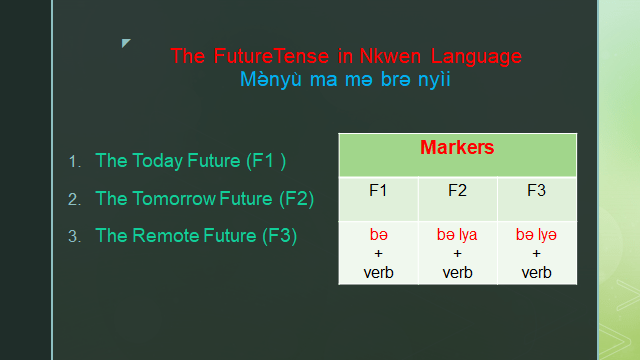
Nkwen Language The Future Tense

Advertisements

Nkwen Language Future Tense

Nkwen Language Future Tense


https://www.youtube.com/watch?v=DT0RktLKNs8&list=PL_ihUsy6_PLIc4fZ4BAf2WyDY6Q3AiLHm
Advertisements
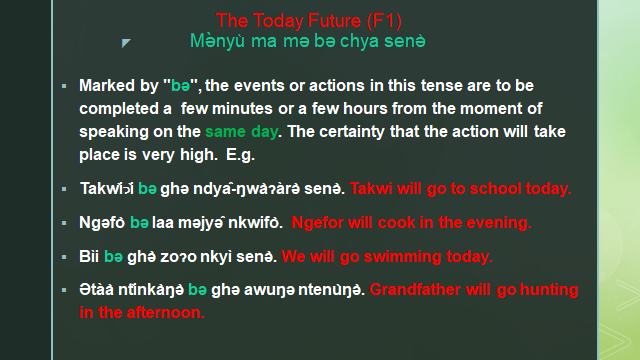
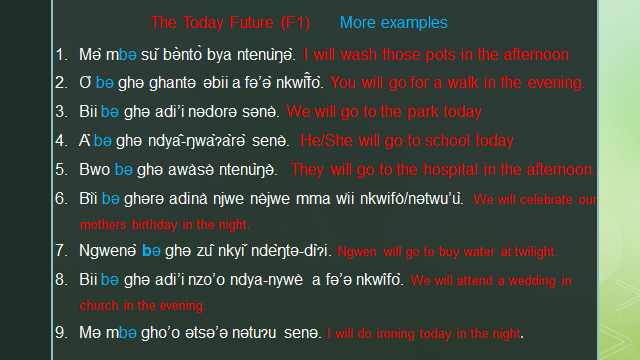
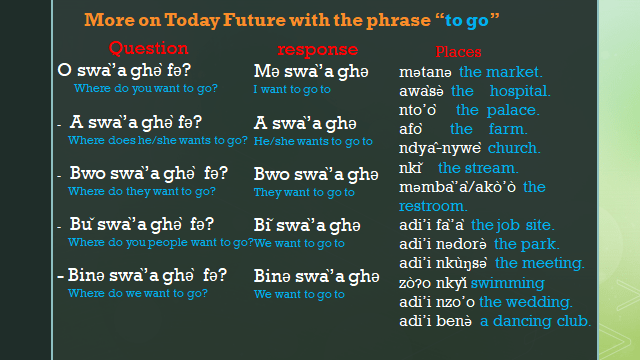
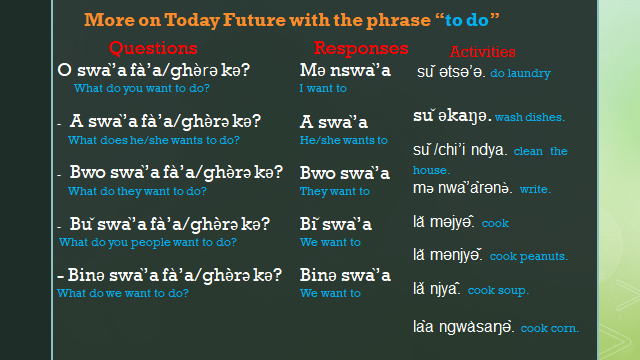
  1. THE TODAY FUTURE F1
Speaking Lessons Online Part 1. Mother Tongue Education in Nkwen Language https://www.youtube.com/watch?v=DT0RktLKNs8&list=PL_ihUsy6_PLIc4fZ4BAf2WyDY6Q3AiLHm
Advertisements
https://www.youtube.com/watch?v=DT0RktLKNs8&list=PL_ihUsy6_PLIc4fZ4BAf2WyDY6Q3AiLHm
Advertisements
https://www.youtube.com/watch?v=DT0RktLKNs8&list=PL_ihUsy6_PLIc4fZ4BAf2WyDY6Q3AiLHm
Advertisements
Nkwen Language Future Tense
Advertisements

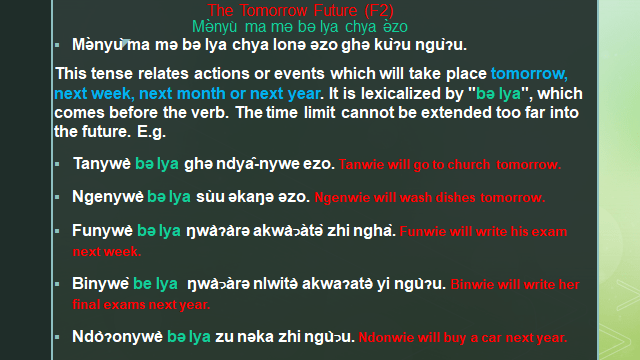
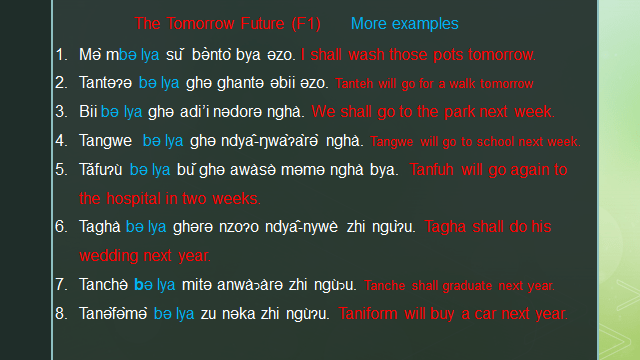
2. THE TOMORROW FUTURE F2

Nkwen Language Future Tense
https://www.youtube.com/watch?v=DT0RktLKNs8&list=PL_ihUsy6_PLIc4fZ4BAf2WyDY6Q3AiLHm
Advertisements
Nkwen Language Future Tense
https://www.youtube.com/watch?v=DT0RktLKNs8&list=PL_ihUsy6_PLIc4fZ4BAf2WyDY6Q3AiLHm
Advertisements

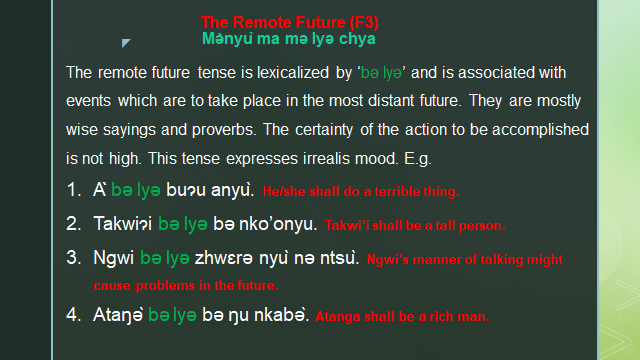
3. REMOTE FUTURE F3

Nkwen Language Future Tense
https://www.youtube.com/watch?v=DT0RktLKNs8&list=PL_ihUsy6_PLIc4fZ4BAf2WyDY6Q3AiLHm
Advertisements
Nkwen Language Future Tense
https://www.youtube.com/watch?v=DT0RktLKNs8&list=PL_ihUsy6_PLIc4fZ4BAf2WyDY6Q3AiLHm
Advertisements

Related Lessons

Nkwen Language Lessons

Nkwen Language Gospel Readings For Year C

Nkwen Language Counting 1 – 1000 Mǝ̀seŋtǝnǝ̀

Classification of Nouns in Nkwen Language

Aspects Of The English Language

Basic Mathematics

Blog

Home

http://www.youtube.com/c/TaminangThereseN

Advertisements

Latest Posts

Advertisements

Nkwen Language Past Tense

https://youtube.com/c/TaminangThereseN

Advertisements

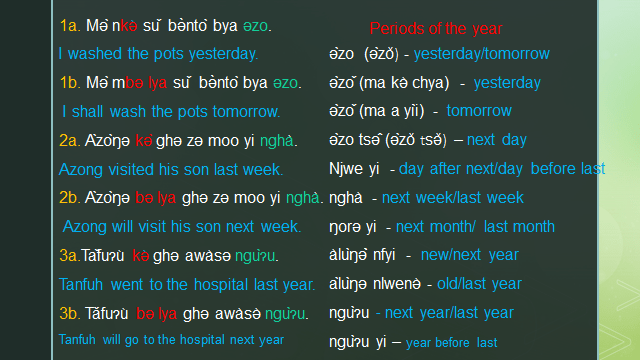
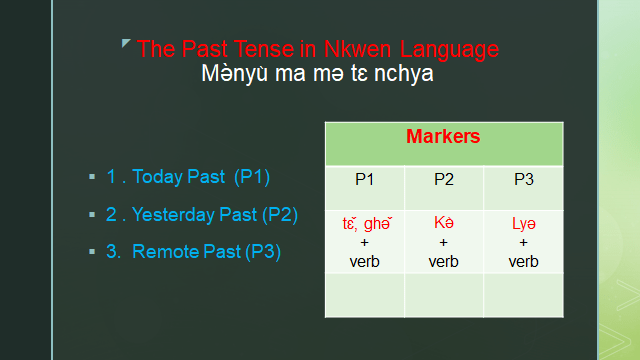
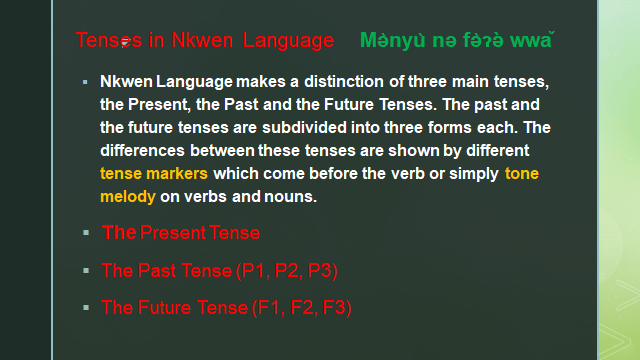
The Nkwen Language makes a distinction of three main tenses, the Present the Past, and the Future Tenses. The past and the future tenses are subdivided into three forms each. The differences between these tenses in some cases are shown by different tense markers which come before the verb or simply tone melody on verbs and nouns.

Advertisements

TABLE 1: TENSE MARKERS

Speaking Lessons Online Part 1. Mother Tongue Education in Nkwen Language https://www.youtube.com/watch?v=hUxKr8OnLBI&list=PL_ihUsy6_PLIGXM9vFSgIaP5EP1vbDokZ
Advertisements

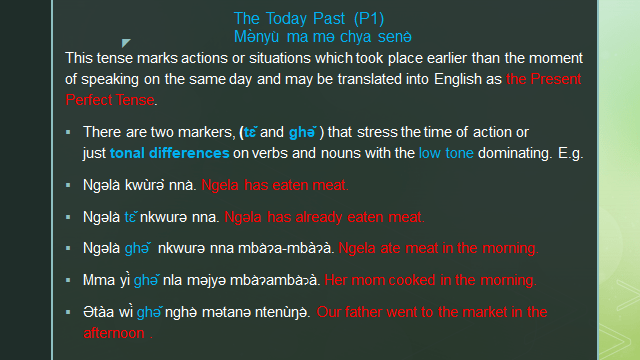
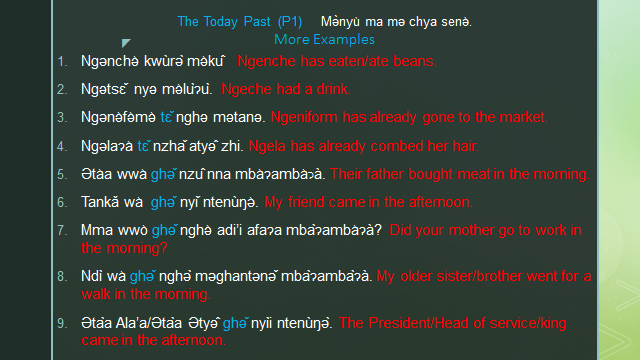
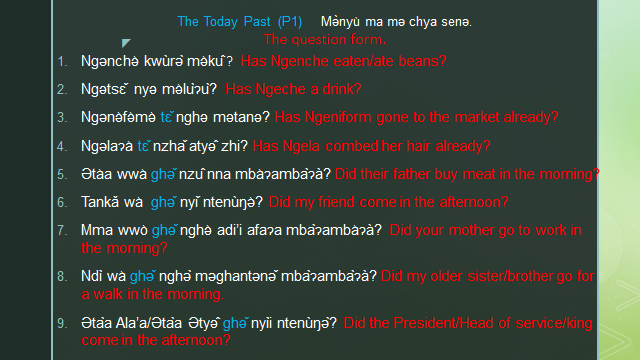
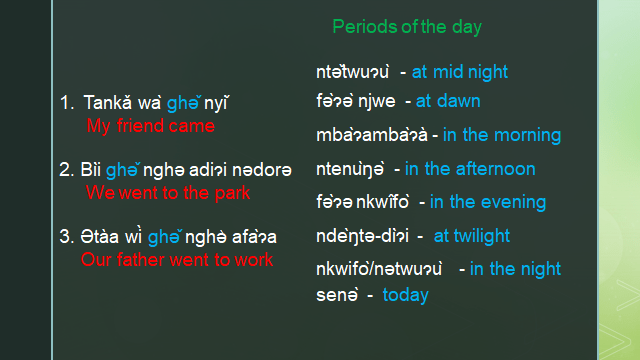
THE TODAY PAST (P1)                

https://youtu.be/TqW_uakcJ2o
Advertisements
https://www.youtube.com/watch?v=hUxKr8OnLBI&list=PL_ihUsy6_PLIGXM9vFSgIaP5EP1vbDokZ
Advertisements
https://www.youtube.com/watch?v=DT0RktLKNs8&list=PL_ihUsy6_PLIc4fZ4BAf2WyDY6Q3AiLHm
Advertisements
https://www.youtube.com/watch?v=DT0RktLKNs8&list=PL_ihUsy6_PLIc4fZ4BAf2WyDY6Q3AiLHm
Advertisements
https://www.youtube.com/watch?v=DT0RktLKNs8&list=PL_ihUsy6_PLIc4fZ4BAf2WyDY6Q3AiLHm
Advertisements

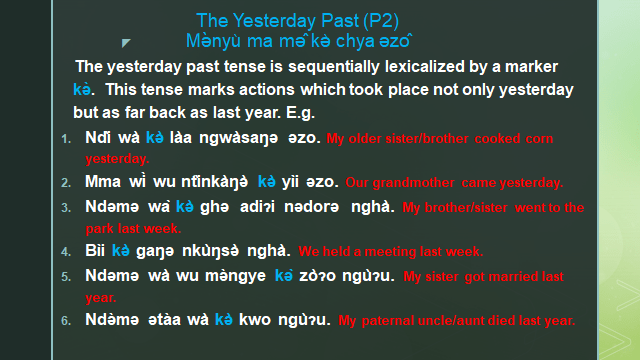
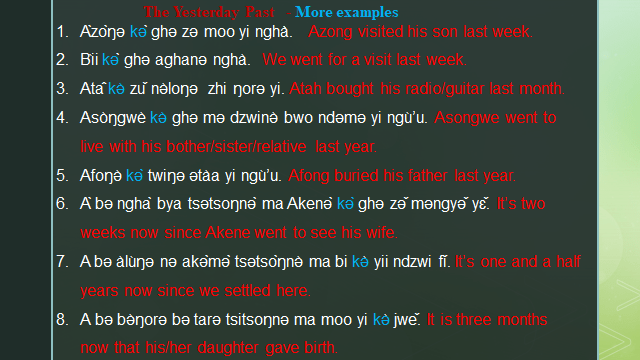
THE YESTERDAY PAST (P2)

https://youtu.be/gYYxdT_8Yk8
Advertisements
https://www.youtube.com/watch?v=DT0RktLKNs8&list=PL_ihUsy6_PLIc4fZ4BAf2WyDY6Q3AiLHm
Advertisements
https://www.youtube.com/watch?v=DT0RktLKNs8&list=PL_ihUsy6_PLIc4fZ4BAf2WyDY6Q3AiLHm
Advertisements

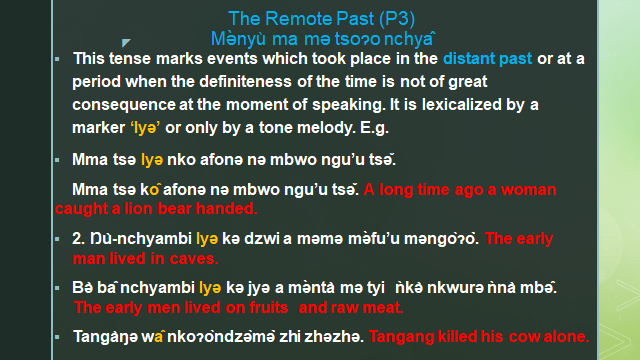
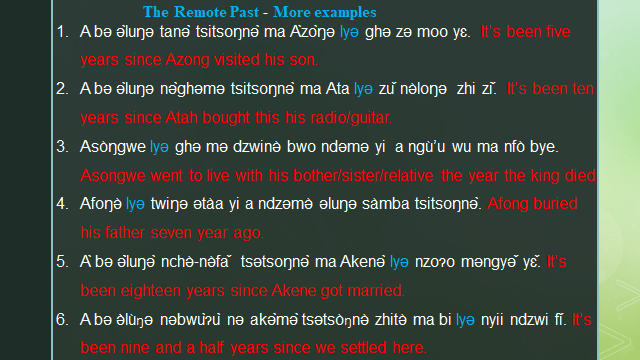
THE REMOTE PAST (P3)

https://youtu.be/AqgaHW5V9Fk
Advertisements
https://www.youtube.com/watch?v=DT0RktLKNs8&list=PL_ihUsy6_PLIc4fZ4BAf2WyDY6Q3AiLHm
Advertisements
https://www.youtube.com/watch?v=DT0RktLKNs8&list=PL_ihUsy6_PLIc4fZ4BAf2WyDY6Q3AiLHm
Advertisements
Advertisements

Related Posts

Nkwen Language Lessons

Nkwen Language Gospel Readings For Year C

Nkwen Language The Future Tense

Nkwen Language Present Tense

Classification of Nouns in Nkwen Language

Aspects Of The English Language

Basic Mathematics

Stories That Bring Great Impact On Life

Home

Advertisements

Latest Posts

Advertisements

Nkwen Language Lessons

https://youtube.com/c/TaminangThereseN

Nkwen Language The /b/ sound

Advertisements
https://youtu.be/hUxKr8OnLBI?list=PL_ihUsy6_PLIGXM9vFSgIaP5EP1vbDokZ
Advertisements

This sound /b/ occurs more frequently in Nkwen Language. It is a consonant that comes at the initial and medial positions in some words. It doesn’t feature at the final position. It is also used in “bǝ̀” (a marker used to form the plurals of some nouns) and “bǝ” as in the future tense markers; “bǝ, bǝ lya, and bǝ lyǝ. Here are some examples of words with the sound /b/ and a short reading exercise on this sound.

Advertisements

B b
bǎtә̂ → to break (into many pieces)
basǝ̂ → to paste
bὲˀὲtә̂ → to peal

bǝ̀bǝ̀rǝ̀ → a kind of bird.

banǝ̀ → corn fufu/bread

bǎtǝ → wine calabash

bǝ̀bǎtǝ̀ → wine calabashes

bǝ̀ntò → pots

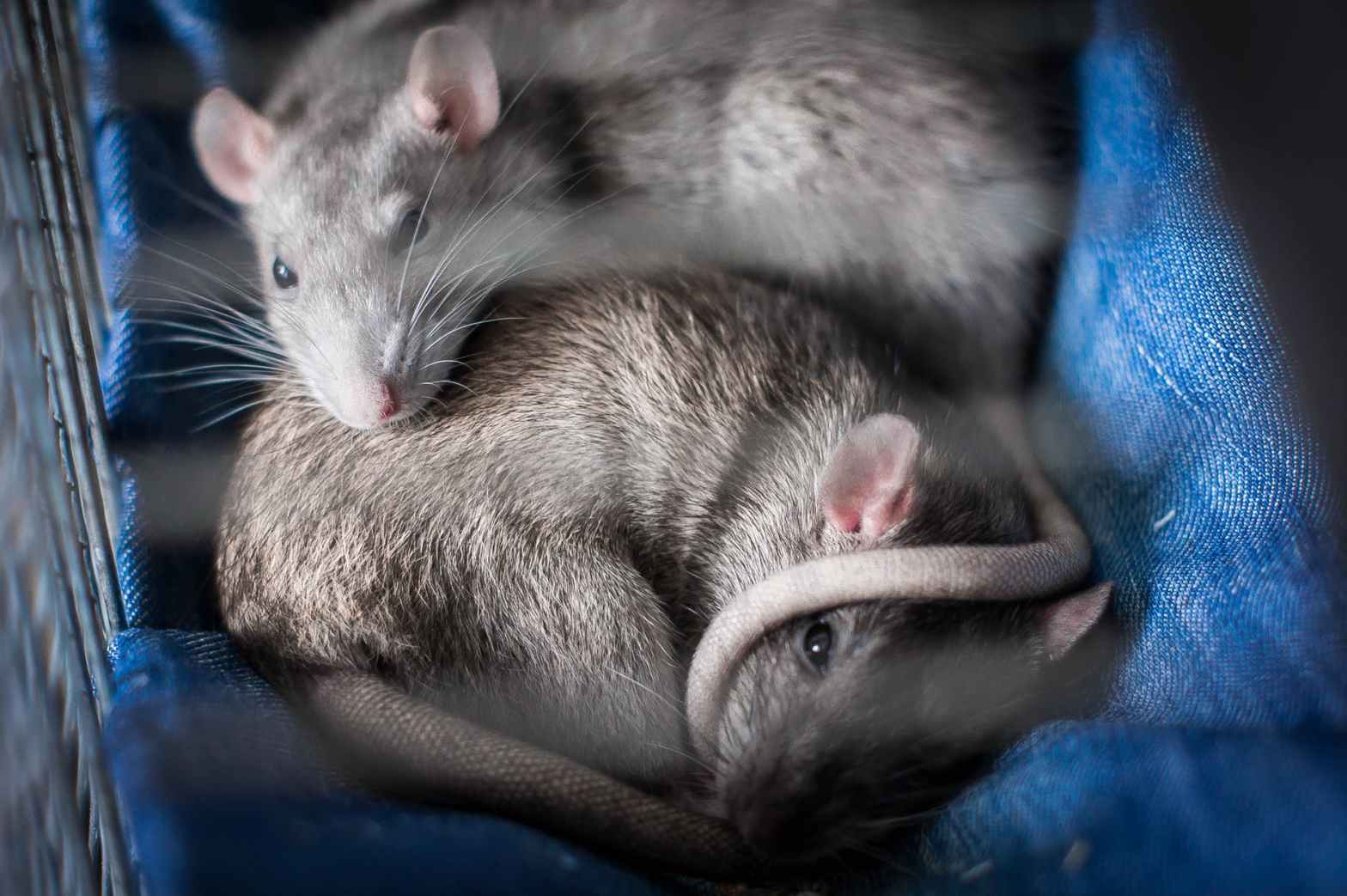
bǝ̀forǝ → rats

bǝ̀fò → fons

bǝ̀sǝŋǝ – birds

Advertisements

bεntә → to pick
biŋә → to accept
bìtә̌ → to add
biŋsә̂ → to ask
bә̀ŋnә̌ → to wake up
bisә̂ → to smoothen
bàntә̂ → to hate
bὲˀὲsә̂ → to encourage negatively
borәsә̂ → to calm
buˀutә̂ → to nail

Bǝbanǝ̀ > a name (f)

Advertisements

Mә̀toŋtәnә̀ – Reading
Bәbanә̀ à bὲntә̌ mâkàbә̀ nkuŋǝ, mbatә. A bә sùu, niŋә mәmә ǹtò tiˀi bìtә̀ mәwurә bwo fә̀ngwaŋә wә. À bὲˀὲtә ǹgòrәnkwi mә tǒnә̀ wә a byì. Moo yi bә bәŋnә jyә ghә yi ndya àŋwàˀàrә̀. À bǝ kǝ jyǝ ti’i ghǝ̀ yi afò. À bǝlya ti’i ǝla bǝ ǝ̀banǝ mbà’ambà’à ǝ̀zǒ.

Free Translation

Beban has gathered some cocoyams, peeled and break into pieces. After washing, she will put it in a pot then add salt and oil. She has peeled tree bark to use for fire to cook it. Her daughter will wake up and eat before going to school. She will also eat then go to the farm. Tomorrow morning, she will prepare corn fufu instead.

Advertisements

Related Posts

Nkwen Language The /a/ sound

Nkwen Language Lessons

Gospel Readings in English and in Nkwen Language For Year B

Classification of Nouns in Nkwen Language

Aspects Of The English Language

Basic Mathematics

Home

Latest Posts

Advertisements

Nkwen Language Lessons

Nkwen Language The /a/ sound

Advertisements
https://www.youtube.com/watch?v=hUxKr8OnLBI&list=PL_ihUsy6_PLIGXM9vFSgIaP5EP1vbDokZ
Advertisements

The /a/ is a vowel in Nkwen Language. It comes mostly at the initial and medial positions in some words. It also features at the final position in names and mostly in words modified by the glottal stop or the long /ar/ sound. It is also a pronoun for “He/she”. Examples:

Advertisements

A  a      

àkaŋә̀              a pan

àkoŋә̀             an umbrella

àkenә̀             a trench

zɛ’ɛ̀ – a name (m)

àbàˀà              a door

bàà – a bag

Tal – a name (m)

Ngǝl – a name (f)

Ngǝla’à – a name (f)

àlǝ̀ŋә                a chair

àliliŋә               a bat

àfùfùˀù        a cockroach

ànkarә̀          a  burnt ridge

àfә̀fàrә̀       a weaver bird

àzuˀù          a yam

àdzò              a plum

àzarә̀          a funnel

àtsaŋә̀              prison

àshìshì             thread

Advertisements

Mә̀toŋtәnә̀ (Reading)

Àzεˀὲ nyεˀε àbàˀà, àliliŋә darә nku  ndya. Àzuˀu dzwi mәmә̀ ǹtò ma Lә̀mә̀ à toŋә nә ànkarә̀ zhi. À bә kwurә azuˀu zhi  nә àdzò tiˀi mitә tatә atsә̀ˀә zhi nә àshìshì.

Free Translation   

Azeh has opened the door and a bat has flown into the house. There are yams in the pot that Lem has harvested from her burnt ridge. After eating her yams with plums, she will stitch her dress with thread.

Advertisements

Related Posts

The /dz/ sound in Nkwen Language

plurals-of-nouns-in-nkwen-language.pdf

Nkwen Language Lessons

Aspects Of The English Language

Responsorial Psalm Chants For Sundays

Nkwen Language Gospel Readings For Year B

Stories That Bring Great Impact On Life

Poems About Life

Advertisements

Latest Posts

https://youtube.com/c/TaminangThereseN

Advertisements

Nkwen Language Lessons

The /d/ sound in Nkwen Language

Advertisements

D d

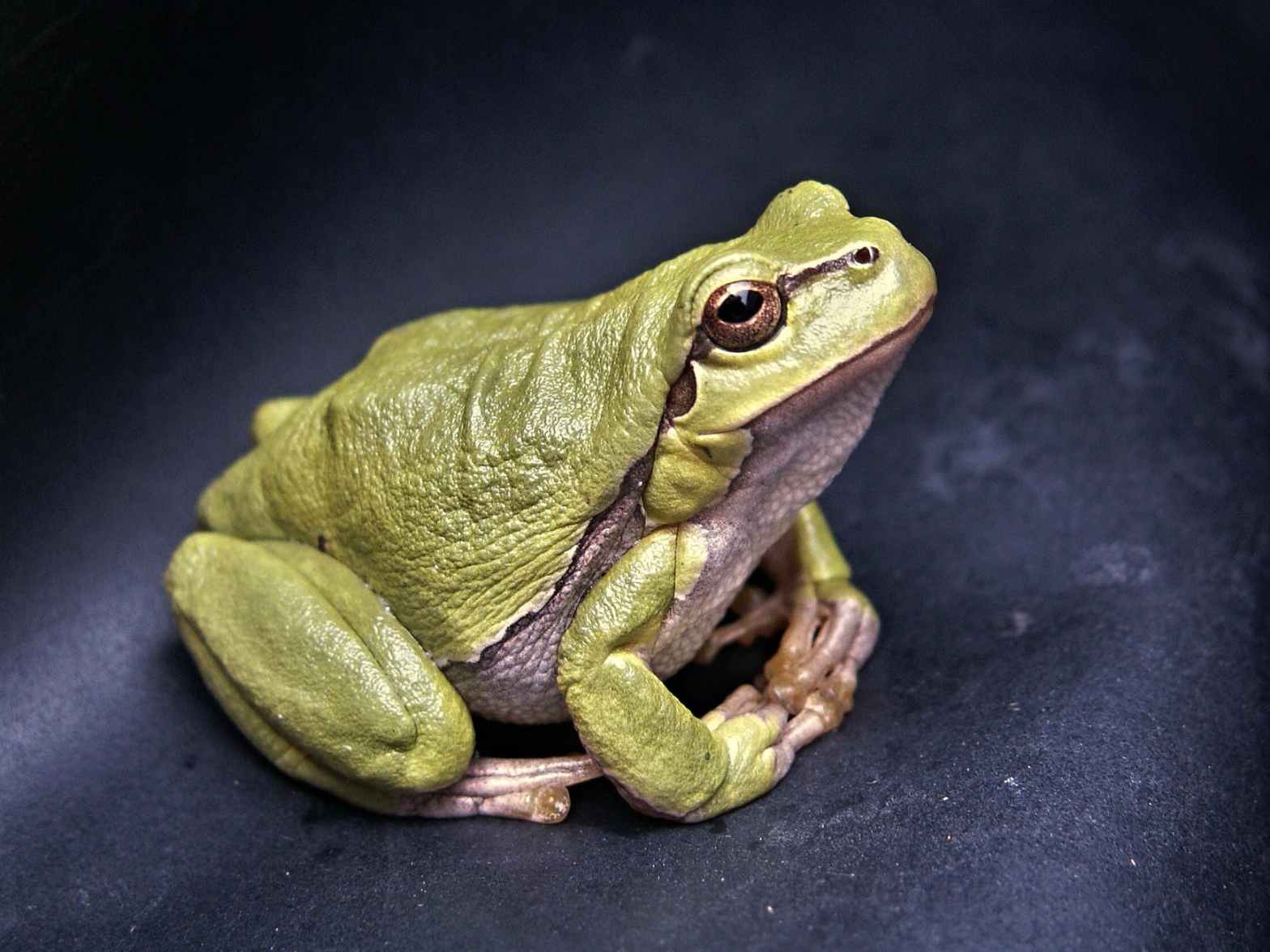
dәdoˀo → a frog

https://www.youtube.com/watch?v=nLMEu7XpF0A&list=PL_ihUsy6_PLI5VO1oysx_8h9P52bjXtsz
Advertisements

/d/ is a consonant in the Nkwen Language Alphabet. It occurs more frequently at the initial and medial positions in words. It doesn’t come at the final position. Here are words with /d/ and a short reading exercise in Nkwen Language.

Advertisements

D d
dànә̀ → a wine calabash

dǝ̀ǝ → a wedding song

doŋә̀ → a horn

dәdoˀo → a frog

dàrә̂ → to fly

dә̀sә̂ → to show

dòŋsә̂ → to fit

dòrә̀ → a kind of grass

nә̀dorә̀ → happiness

duŋǝ̀ → husband

dàbàˀà → tobacco

dòˀoǹywè → a name

àdasә̀ → commission

dâbòŋә̀ → a name (m)

dǝ̀mǝ → brother/sister

Advertisements

Mә̀toŋtәnә̀ Reading
Mә̀lùˀù lùu mәmә dànә̀ Ǹdìfò. Bì bә nyә kә dorә. Ǹdòˀoǹywè bә niŋә mâtsә nә ǹdoŋә mabrә. Ətàa nyә mәlùˀù ǹkә nyә ǹdàbàˀà. Ndǝ̀mǝ wà bwo ǹduŋǝ yì dorǝ wwa. Bwo bǝlya zo’onǝ ǝ benǝ ǹdǝ̀ǝ nǝ̀loŋǝ.

Advertisements

Free Translation
Ndifor’s calabash is full of wine. We will drink and play. Ndonwie will fill mother’s wine gorde with some. Father is drinking and smoking tobacco. My sister and her husband are playing. They shall do the wedding dance when they are married.

Advertisements

Related Lessons

Nkwen Language Lessons

Nkwen Language Gospel Readings For Year C

The /ǝ/ sound in Nkwen Language

Advertisements

List of Pages

Advertisements

Latest Posts

https://youtube.com/c/TaminangThereseN

Nkwen Language Present Tense

https://youtube.com/c/TaminangThereseN

Advertisements
Tenses in Nkwen Language https://youtu.be/acZLPXzpsQE BLOG My Patroness Amazes Me Music With Local Instruments 1. My Songs and Lyrics
Advertisements
Speaking Lessons Online Part 1. Mother Tongue Education in Nkwen Language https://www.youtube.com/watch?v=hUxKr8OnLBI&list=PL_ihUsy6_PLIGXM9vFSgIaP5EP1vbDokZ
Advertisements
NKWEN LANGUAGE LESSONS Greetings, family, Alphabet, Tone Marks, Numbers https://www.youtube.com/watch?v=hUxKr8OnLBI&list=PL_ihUsy6_PLIGXM9vFSgIaP5EP1vbDokZ
https://www.youtube.com/watch?v=hUxKr8OnLBI&list=PL_ihUsy6_PLIGXM9vFSgIaP5EP1vbDokZ
Advertisements
Advertisements

Related Posts

Nkwen Language Lessons

Gospel Readings in English and in Nkwen Language For Year B

Nkwen Language Speaking Lessons Online Part 2. Mother Tongue Education

Classification of Nouns in Nkwen Language

Collective, Uncountable, Abstract Nouns and Parts of the Body in Nkwen Language

Nkwen Language The Future Tense

Nkwen Language Past Tense

Nkwen Language Wordlists on Nouns

Advertisements

Latest Posts

Advertisements

https://youtube.com/c/TaminangThereseN

Nkwen Language Lessons

Nkwen Language Scheme of Work

Nkwen Language Scheme of Work: https://youtu.be/OJu37XPb-sc

Advertisements

Nkwen Language Scheme of Works is a proposed plan aimed at assisting Teachers, kids, and students who are in the Nursery, Primary, and Secondary Schools in the Nkwen Fondom, to speak, read, and write the Nkwen Mother Tongue.

Note should be taken that these schemes have been broken down from the National syllabus of the English-speaking primary schools in Cameroon. The aim of this project, as conceived by the Nkwen Language Committee, is to foster the teaching, speaking, writing, and reading of the Nkwen Mother Tongue (MT) in all the Nursery, Primary, and Secondary schools in the Fondom as well as in all its quarters. This will also enable the child to move gradually from his Mother Tongue to the English (foreign) language, which is introduced to him in school.

Advertisements

There are two ways in which this program could be handled in a school system. The first is to use the Mother Tongue as a medium in the teaching/learning process where all the subjects are taught using the Mother Tongue. This is very effective in a situation where nearly all the children in a class speak the same language. The second method is when the Mother Tongue is taught as a subject on the school timetable. Thus, periods are allocated for Mother’s tongue on the timetable. This scheme is broken down into six sequences with many lessons to guide the teaching of the Nkwen Mother Tongue and help the learner develop the following skills.

Advertisements

SCHEMES FOR NURSERY, Primary AND Secondary SCHOOLS

Nkwen Language Scheme of Work – FIRST SEQUENCE

  1. Greetings/simple commands (mә̀tsὲ’ὲtәnә̀:  ǹjwelǎ? a bәla? ò zĭ? ò yĭ? ò bǔ? ò dzwi ǹshi’inә̀?)  Commands: (yĭ! Ghә̌! Tiŋә! Dә̌! Fyâ! Khә̌! Zεˀεtә! tiŋә ndәŋә! Nunә nshye! Lìnә! Fu abi! Ku nyĭ! zhwinә! Kĭ!  Tsәmә̀! Wwe!
  2. Self introduction (ә̀lwenә̀ wa bә…, mә̀ mbә…, mә̀ mbә ә̀lùŋә̀ nә̀kwà, ә̀lwenә әtàa wà bә…, ә̀lwenә mma wa bә…, mә dzwi fәfә….)
  3. Introducing others. (li bә…, a dzwi fe …, à fu fә…, a fà’a fәfә…, a dzwi nә̀ әboo bi…
  4. Polite request and appreciation. (lontә wa nә̀…, ti boŋә ɔ̀ lontә̀ wa nә̀…, tәkò’o mәyà, Mәyà wwɔ̀.)
  5. Identification of objects (at home, school, environment), nouns
  6. Pronouns: mine, yours, his/ hers, ours, theirs, yours (pl), these, that, those. (wà, wwò, yε̌, wĭ, wwă, wwǔ, bìi, wa, bya.) 
  • Kitchen utencils and plurals. (àkaŋә̀ – ә̀kaŋә̀, àlә̀ŋә – ә̀lә̀ŋә, ǹtò -bә̀ntò,  etc.
  • Classroom equipment and plurals. (m̀bәŋә̀ – m̀bәŋә̀, àŋwà’àrә̀ – ә̀ŋwà’àrә̀, ǹkoŋә-aŋwà’àrә̀ – mә̀nkòŋә̀ mә aŋwa’arә, tafrә̌ – bǝ̀tafrә, fәtù – bә̀fәtù, etc)
  • Parts of the Body and plurals.( àtyә̂ – ә̀tyә̂, ǹtòŋә – mә̀tòŋә, nә̀tòŋә – mètɔ̀ŋә, àkù – mә̀kù, etc)
  • Places. (àdì’i  – ә̀dì’i, àfò  – ә̀fò, àtò’ò – ә̀tò’ò, àtyә-nta’à – ә̀tyә-mә̀nta’à, mә̀tànә – bǝ̀mǝ̀tanǝ

https://youtube.com/c/TaminangThereseN

Advertisements

Nkwen Language Scheme of Work – SECOND SEQUENCE

  1. Identification of characters or letters of the alphabet ( a, b, ch, d, dz, e, ɛ, ǝ, f, g, gh, i, j.…etc)
  2. Reading letters of the alphabet. ( a, b, ch, d, dz, e, ɛ, ǝ, f, g, gh, i, j.…etc)
  3. Writing Letters of the Alphabet. ( a, b, ch, d, dz, e, ɛ, ǝ, f, g, gh, i, j.…etc)
  4.  Countingmò’o, bya, tarә, kwà, tanә, ǹtǔ, sàmbâ, nә̀fă, nә̀bu’u, nә̀ghǝmә̀, ǹchә̀-mò’o, ǹchә̀-bya, ǹchә̀-tarә, etc.
  5.  Use of the present continuous tense and picture reading. (Ngәfò a chu’u akù’u, Talǎ wà nna, etc)
  6.  Description of a picture / Pictures of animals, pets, their names, and nature. ( ò zә kә mәmә fәtu wǐ? A gha a la? A ghe a fә? Etc.

 Animals (1. ǹgwo, ǹgwu, 3.  àŋkә’ә, 4. mya-ngwu, 5.  bushì, 6. mbyi-ndoŋә, 7. mbyi-ǹdzɛ̀rә, 8. ànkwùŋә̀, 9. àlwenә̀, 10. àkwi-mbyi, 11. kwunyàmә̀, 13. ǹnà-mәkarә, 14. dedo’o 15. tsә̀tsà, 16. ǹsànkyî, 17. chichi’i, 18. nәnaŋә, 19. kaa, 20. àcә̌, 21. fәnyә, 22. ǹkànә, 23. nkâbàŋә̀, 24. kàŋә, 25. tò’orә, 26. àntswìŋә, 27. tәkwurә-mәlә̀ŋә, 28. m̀byi-mә̀lù’ù, 29. fә̀bu’ù, 30. ǹnà-nkyî, 31. m̀bòŋә̀, 32. nghâ, 33. ǹnarә̀,  34. ǹsenә̀, 35. cùwe, 36. àfònә, 37. ǹnà-nwe, 38. ǹdzǝbә̀rә̂, 39. ǹdzǝbә̀rә̂-ntingùŋә, 40. m̀biyandùŋә, 41. kә̀bә̀, 42. babәngò’ò, 43. swigәrә-ǹkà’aŋkà’à, 44. dòŋfawurǝ̀, 45. dzàkashi, 46. àliliŋә, 47. forә, 48. swìŋnә̀, 49. ǹnǎ-ngyә̀’ә, etc)

  1. Birds: 1. tso’o, 2. wàrә̀, 3. àfә̀fàrә̀, 4. àyìyὲ, 5. tsowε̌, 6. Bu’urә-mә̀kû, 7. kwùŋǝ̀, 8.bǝ̀bǝ̀rǝ̀, 9. tsokò’o, 10. tòŋә̀, 11. mә̀nenә̀, 12. sәŋә-lyәbu, 13. àŋәŋya, 14. wazε’εmoo. àngù’u, 16. fә̀tòŋә, 17. kwa’atә-tyi, 18. kò’òdziŋә.
Advertisements

Nkwen Language Scheme of Work – THIRD SEQUENCE

  1. Trees / grasses (әtyĭ:  ǹgà’a, àgǝ̀mә̀, fù, wàrә̀, àkәkwε, ǹfàbә, àfәfaŋәàngwenә, ǹkòŋә, ǹdzàŋә, àkànә̀, lònә, ǹsàrә̀, bàŋә̀, àluŋә̀, bὲrә̀,                       ǹdzoŋә-ndzoŋә, bya, frәsә̀garә̀) Grasses: ǹgwenè: àsә̀soŋә̀, achi’inә̌, tәtya nywὲ, ǹsǔ, ǹsǔ-ngha, sὲmbε’ε, àswĭnkyi, nә̀’ә, chisәghòrә̀, lànshye, ǹdi’i, bàŋndzә̀m-mò’o, nә̀ghonә̀, m̀mi me ngwu, ǹkyi-nkyi mmi, nә̀kòŋә̀ nә bәnkhә, ǹdorә̀, fi-ndzoŋә, fi la’a, ǹkә̀ŋә, ǹgә̀ngɔ̀rә-nkә’ә, etc
  2. Fruits:  m̀bεrә, ǹsàrә̀, fә̀jyә, àdzò, ǹtàŋә̀, àntsò’ò, m̀bànta’à, mәmbɔ̂, nә̀bò’o nә nkyi-nkyi, àsәsaŋә, ǹfàgә̀lùŋә̀, lamshì, bòbo mangòrә̀, nanashì, ǹgwabàŋә̀, fә̀mbà.
  3. Simple questions. Listening and responding.( lya bә kә? ò swa’a a gha la? ò dzwi nә̀ nkabә̀ dàŋә fya, a li mbe  bә ntamә Ngu’u zha? Responses: kǎka,  à a, ǹgaŋә, anyu dàŋǝ! kye, ǎndε!
  4.  Rhymes. Possessions(bә̀sәŋә ba, bә̀sәŋә bwo, bә̀sәŋә byi, bәsәŋә bu, bә̀sәŋә bya. ǹnà za, ǹnà zhә̀,… m̀bεrә wwa, mbεrә wwo,…, fә̀ngwaŋә̀ fa, fә̀ngwaŋә̀ fwo,…mә̀lu’u ma, mǝ̀lu’u mwo,… mә̀lu’u muu
  5.  Riddles and jokes (ǹkwalә̀’ә – lә̀’ә̀nkwa: nòŋә̀ li, nòŋә li = ә̀bǔ, tiŋә atyә nta’a nkwusә akoŋә̀ zhǝ  – ә̀bo’o , etc.
  6. Story telling (ǹkwalә̀’ә, lә̀’ә̀nkwa, Ətaa/Mma tsә dzwi yi wu, …)
  7.  Common games and rules.(ǹnà ǹnà kuku, ò bye lo, tu’u mbyi Sunde Màriyà, bә̀sәŋә bә mba’amba’ chya nzε’εsә atyә muwi, tsәmә wwo muwi tsәmә wwo lә.

https://youtube.com/c/TaminangThereseN

Advertisements

FOURTH SEQUENCE

  1.  Parts of the body and their functions (the five senses)(Mә zә әdi’i nә m̀mi ma, mә fa’a nә m̀bwo ma, mә lә̀msә̀ nә mә̀lwi ma, mә zu’u nә әtugәrә dzwa, mә jyә nә ǹtswù wwa, etc)
  2. Sources and  Importance of water(mә̀ză, ǹkyi fәngwaŋә̀, nә̀fĭ, àtsә̀mә̀, ghә̀ŋә̀, ǹkyî-ngorә̀, karә-ghәrә): (ǹkyî mә nyәnә̀, ǹkyî la mәjyә, ǹkyî sǔ nnu, ǹkyî sǔ tsә̀’ә, etc)
  3. Questions and discussion on health.   – Toiletries (Boŋә ò gha la mә ghәrәnә̀ ngә ǹnu zhә̀ nwa’a? , mә swà’a ghә mәmbà’à, etc
  4.  Cleaning tools and their functions (asɔ̂, ǹnywe, mә̀saŋә̀, nә̀kyǐ,, etc)
  5.  Describe actions in a chronological order eg 1st, 2nd, 3rd, 4th, etc. (ǹchyàmbì, àzòŋtә̀, adì’i tarә,  adì’i nәkwà, etc, ǹlwitә̀.) ̀
  6. Foodstuffs, common meals, different meals. (ǹgwàsaŋә̀, àzu’u, mәnjyә̌, fә̀ndә̀ŋә̀, màkàbә̀, mә̀kû, kàsarә̀, nә̀bò’o, nә̀ngùŋә, mәmbɔ̂, mә̀tu’u mә tyi, mètu’u mә әkàrә, ǹdòŋә, mәmbaŋә, ә̀kù’u la’à, ǹtàgә̀là) Meals:(àkù’u nә̀ njyâ-nә̀kyǐ, ǹgwàsaŋә nә̀ mәŋjyә̌,  mә̀ku mә karә nә ǹjya mә̀kaŋәtә, etc)
  7.  Description of journeys,  (mә̀ ghә̀ mәtanә, mә ghә ntεnә̀, mә ghә afò, mә ghә aghanә̀, mә ghә ndyâ ǹtswa’à, mә nku nkyî,  mә ku nto’o, mә ko’o nta’à, etc) 
Advertisements

Nkwen Language Scheme of Work – FIFTH SEQUENCE

  1.  Expressions in the past tense (today, yesterday and remote past) (à ghә nla akù’u mba’a-mba’a, à tε nla akù’u, à kә̀ laa akù’u әzo/ ǹghà/ngù’u,  a lyә nla akù’u)
  2.  Simple expression of feelings / Expressions in the future tense. eg I like it. It is good.(mә̀ kòŋә, mә̀ koŋtә ngә, à bòŋә wwa, / à bә ghә̀ mәtanә,  à bә lya ghә̀ mәtanә әzo / nghà/ngù’u, ă lyә ghә̀rә/bù’u nyù, etc.)
  3.  Types of professions (occupations) and their functions. (ǹtâ-tsǝ̀’ә, ǹghùrә̀-mә̀la’à, ǹtyә̂-khә̌, ǹkuŋә̀-tyә, m̀ba’à-ǹkyὲ, ŋù-ngàŋә̀, ǹtsu’ù mә̀ghònә, ǹgàŋә sa’a mәnsa’a: m̀fò korә̀, bә̀ta bә korә̀, ǹsa’à mә̀nsa’à, ǹtsὲrә̀ mә̀nsa’à, ǹtò’òtә̀ mә̀nsa’à, etc
  4.  Days of the week. Yesterday, tomorrow.(Zә̀ntye, Zә̀nkhalye, Zә̀lye, Zә̀nkhaka-Zәkă, Zә̀kă, Zә̀zĭ, Zә̀ngәfә̀kwenǝ, Zә̀nkhaka-zәntye, zәntye ; ә̀zo ma à kә̀ chya, ә̀zo ma a yìi, etc)
  5.  Activities and duration, telling the time and date, months (fә̀’ә̀ li’i mәsuŋә, fә̀’ә̀ mә̀jyә, fә̀’ә̀ fә̀lye, fә̀’ә̀ bә…, ǹjwe senә bә…, etc, months:1. ŋorә ǹchyambi, 2. ŋorǝ̀ àbә̀bә, 3. ŋorǝ̀ ǹcǔmbә̀ŋә̀, 4. ŋorǝ̀ àzhә̌, 5. ŋorǝ̀ shә̌ ngwenә̀, 6. ŋorǝ̀ ǹwùŋnә̀ alùŋә̀, 7. ŋorә mә̀ghă kә nә̀fu’u, 8. ŋorǝ̀  mǝ̀kû mә lùŋә̀ kә àlansә̂-mbә̀ŋә̀, 9. ŋorǝ̀ ǹtswusanә, 10. ŋorǝ̀ ŋ̀wà’àsànә, 11. ŋorǝ̀ ǹgwenә, 12. ŋorǝ̀ krәsә̀menә̀)
  6.  Description of the weather.(abì ŋwa’à / boŋә̀, abì bǝ̀ǝ, ә̀dì’i ŋwa’à, әdì’i senә, m̀bә̀ŋә shwi’i, m̀fә ko, ә̀dì’i lùŋә, ә̀dì’i fye, etc

https://youtube.com/c/TaminangThereseN

Advertisements

SIXTH SEQUENCE

  1.  Location of objects, persons and animals (bәsәŋә dzwi atyә ati, bә dzwi afo, mәna dzwi a mәmә ba’a, etc)
  2.  Ages. Pronunciation, stress and intonation.(Tone marking) (   ̀ ׳ ˆ ˇ ) 

̀̀       àbà, àsәŋә,

      ׳  sәŋә, fәfә, forә (the high tone is respected but not marked)

ˆ      sâ, fâ, 

ˇ      să, fă 

  1.  Synonyms and Antonyms ( to harvest: fù’u, tsò’o, kha, toŋә̀, bεnә̀, sә̀ŋә, fàrә, sorәtә, wă, kә’ә asәsaŋә, to plant:wε̌, shwuε, zεrә, mà’anә, kә’ә̀, fә̀mtә, anthonyms; àbòŋә̀ – ә̀bwu, bàŋә̀ – shi, ghà’àtә – khә̌tә, sǎtә – kә̀mtә, mә̀ngye – mә̀mbàŋnә̌, Mәǹgenә̀ – Tanzò’o,)
  2.  Labelling of object and colouring. ( èdzwuŋә dzwà sὲnә, bàŋnә, fә̀bә̀nә, ŋwὲ’ὲrә, fùŋnә,)  
  3. Counting 100 – 100,000 :Counting 100 – 100,000 : (ǹkὲrә̀, ǹkὲrә̀ nә àzuŋә- mò’o (101/ǹkὲrә̀ nә ә̀dzuŋә nә̀ghәmә̀ (110), ǹkὲrә̀ nә ǹchǝ̀-mò’o (111), ǹkὲrә̀-bya (200), ǹkὲrә̀-tarә (300), nkὲrә̀-nә̀kwà, ǹkὲrә̀-tanә̀, nkὲrә̀-ntǔ, ǹkὲrә̀-sàmba, nkὲrә̀-nә̀fǎ, ǹkὲrә̀-nә̀bù’u, ǹchù’u, nchù’u nә ǹkὲrә̀-nә̀bù’u, ǹchù’u bya, ǹchù’u tarә, ǹchù’u nә̀ghǝmә̀, ǹchù’u ǹchә̀-mò’o, ǹchù’u ǹchә̀-bya, ǹchù’u ǹchә̀-nә̀bù’u, ǹchù’u mә̀ghәmә mәbya,  ǹchù’u mә̀ghǝmә metarә, àbà nkabә̀, ә̀bà bya, ә̀bà tarә, ә̀bà nә̀bù’u, ǹkamә̀, etc
Advertisements

SCHEMES FOR ADULT LITERACY CLASSES IN NKWEN MOTHER TONGUE

We also proposed the following topics as guidelines for any seminar that will be organized for adult learners. The topics are re-arranged with some additions. The adult learners may progress faster or slower, depending on their ability to grasp the lessons. After treating all these topics, the adult learner should be able to speak fluently, read and write the Nkwen Mother Tongue that he/she is already speaking or learning to speak correctly.
Advertisements
  1. Greetings
  2. Self-introduction and Introducing of others
  3. Identification of characters or letters of the alphabet
  4. Reading letters of the alphabet
  5. Writing Letters of the Alphabet
  6. Tone marks
  7. Counting
  8. More on the Alphabet – short passages
  9. Pictures of animals, pets, and their names
  10. Ages. Pronunciation, stress, and intonation.
  11. Trees/grasses
  12. Animals and birds
  13. Synonyms and Antonyms Noun classes
  14. Plural of nouns
  15. Pronouns: mine,  his/ hers, theirs, ours, yours,  these, that, those
  16. Sequential pronouns
  17. The present continuous tense 
  18. The past tense and markers
  19. The future tense and markers
  20. Polite request and appreciation
  21. Simple questions. Listening and responding. (conversation)
  22. Rhymes and poems
  23. Riddles and jokes
  24. Proverbs
  25. The tradition concerning Marriages,    births, deaths, and other celebrations
  26. Common games and rules
  27. Parts of the body and their functions
  28. Essay writing eg Importance of water, etc.
  29. Storytelling
  30. Appreciation  – part of a text  – Sentence construction 
  31. Types  of professions (occupations)  and their functions
  32. Days of the week. Yesterday, tomorrow.
  33. Activities and duration, telling the time and date
  34. Description of the weather.
  35. Common meals, different meals. 
  36. Pictures of animals, pets, and their nature
  37. Synonyms and Antonyms
Advertisements

TEXTBOOKS/DIDACTIC MATERIAL

  1. Primers one and two
  2. Mathematic Book
  3. Let’s learn, write and read Nkwen Language
  4. Some Grammatical Aspects of the Nkwen Language.
  5.  Nkwen language for the Kids.
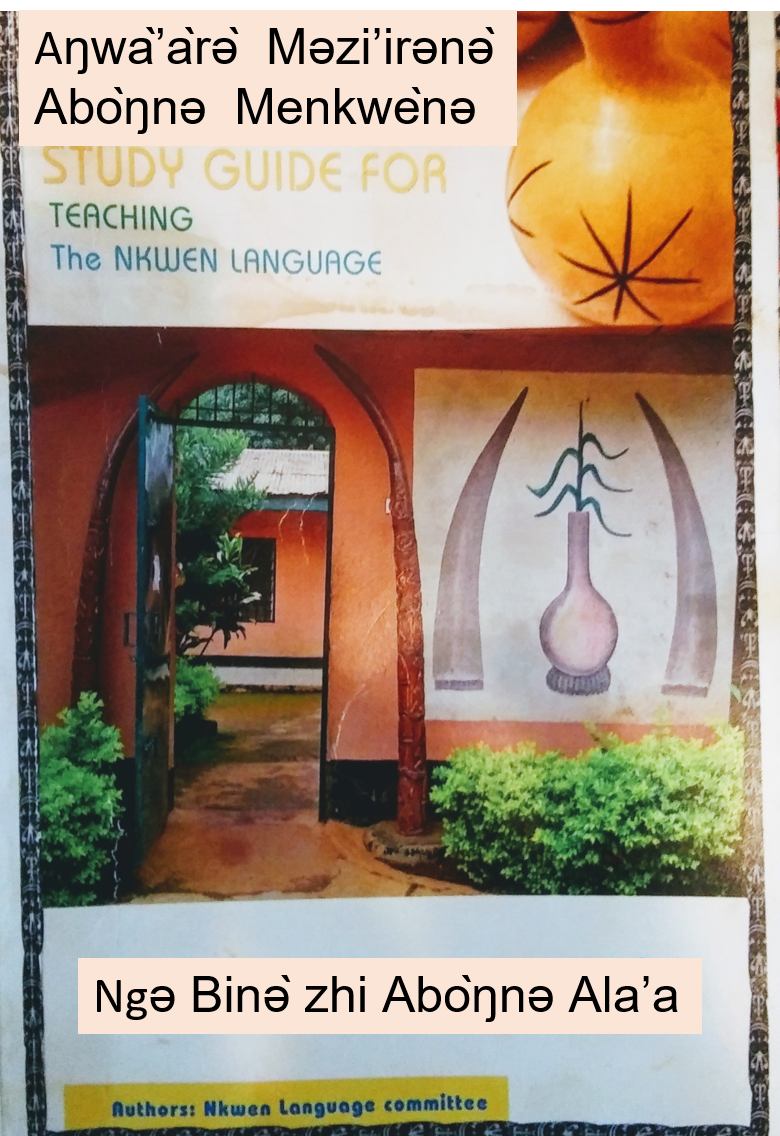
  6. STUDY GUIDE For The Teaching of Nkwen Language

https://youtube.com/c/TaminangThereseN

Advertisements

METHODS

The Teaching/Learning methods to be used are; Questioningdiscussion, demonstrationillustrationstorytellingrhymes and songs, etc. Progress from one lesson to another should depend on how the first one has been mastered by the learners.

This work was done by the following appointed Nkwen language sub-committee members.

  1. Mrs. Taminang Theresia Ngeche
  2. Mrs. Tandia Regina Ngegha
  3. Mr. Joseph Che
  4. Mr. Wankwe Michael 
  5. Miss Usla Na’ah
  6. Mr. Azeh Chrysanthus
  7. Mrs Azefor Emmerentia 
Advertisements

Share this:

Advertisements

Related pages

Nkwen Language Lessons

Gospel Readings in English and in Nkwen Language For Year B

Classification of Nouns in Nkwen Language

Collective, Uncountable, Abstract Nouns and Parts of the Body in Nkwen Language

Nkwen Language Past Tense

https://youtube.com/c/TaminangThereseN

Advertisements